When Dragons Came: A Story in Three Rushnyks

ABOUT THE CASE
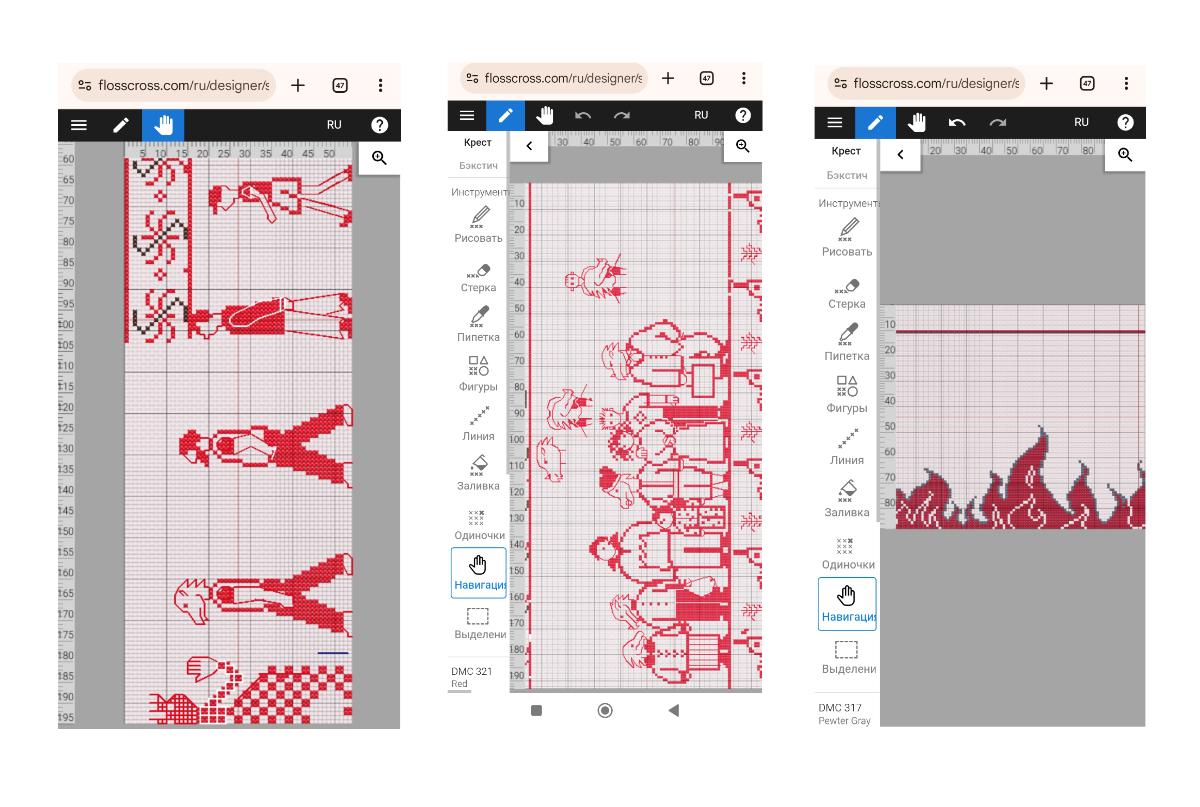
During her artist fellowship with the Leibniz Institute for Regional Geography, Irina Yushchenko finalised this long-term embroidery project documenting personal and transgenerational narratives of the war in Ukraine. We use video and scrolling slider as tools to test different ways of translating the embroidery work into digital space while paying attention to how different voices and perspectives are represented.

A ritual towel, or rushnyk, is a symbolic item of Russian, Ukrainian, and Belarusian culture. Typically, it is a long white towel with ends embroidered with patterned stripes, most often in red colour. Originally, the symbols embroidered or woven onto the rushnyk were graphic depictions of prayers for well-being and harvest, as well as images of deities. However, over time, the rushnyk evolved alongside society while its symbolism and themes of its images changed. When village populations began migrating to cities, the motifs depicted on rushnyks became more narrative, with texts added to the embroidery.

When Dragons Came: A Story in Three Rushnyks continues both the tradition and further transformation of the rushnyk. It explores greater narrativity by using embroidery as a means to tell the story of the war between Russia and Ukraine and the societal changes that arose from this war. The project weaves in personal stories and memories of the author, and her Russian and Ukrainian grandmothers. The narrative component intertwines with traditional symbolism, with the central image being that of a dragon, which in Slavic mythology is associated with destruction and war.
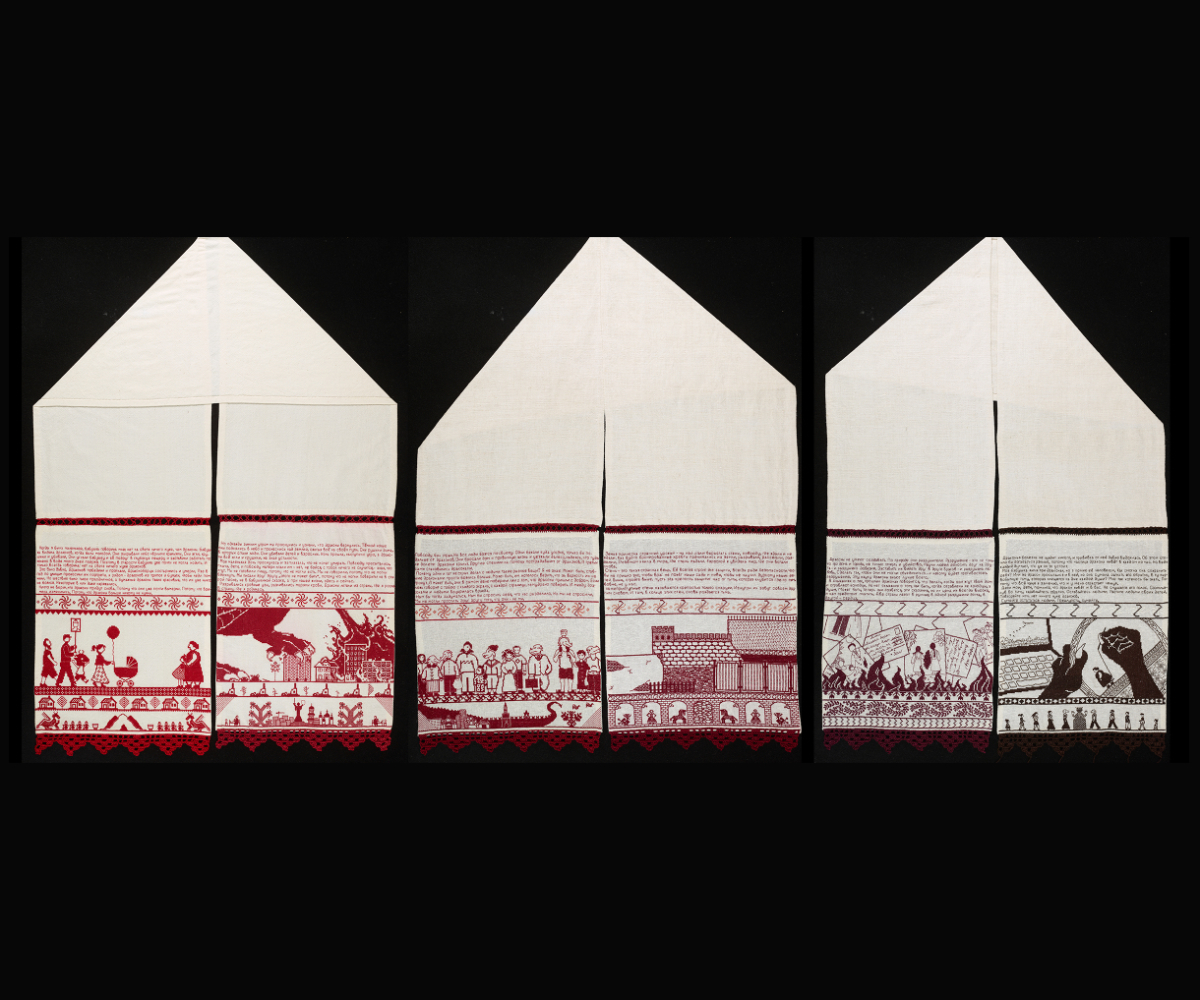
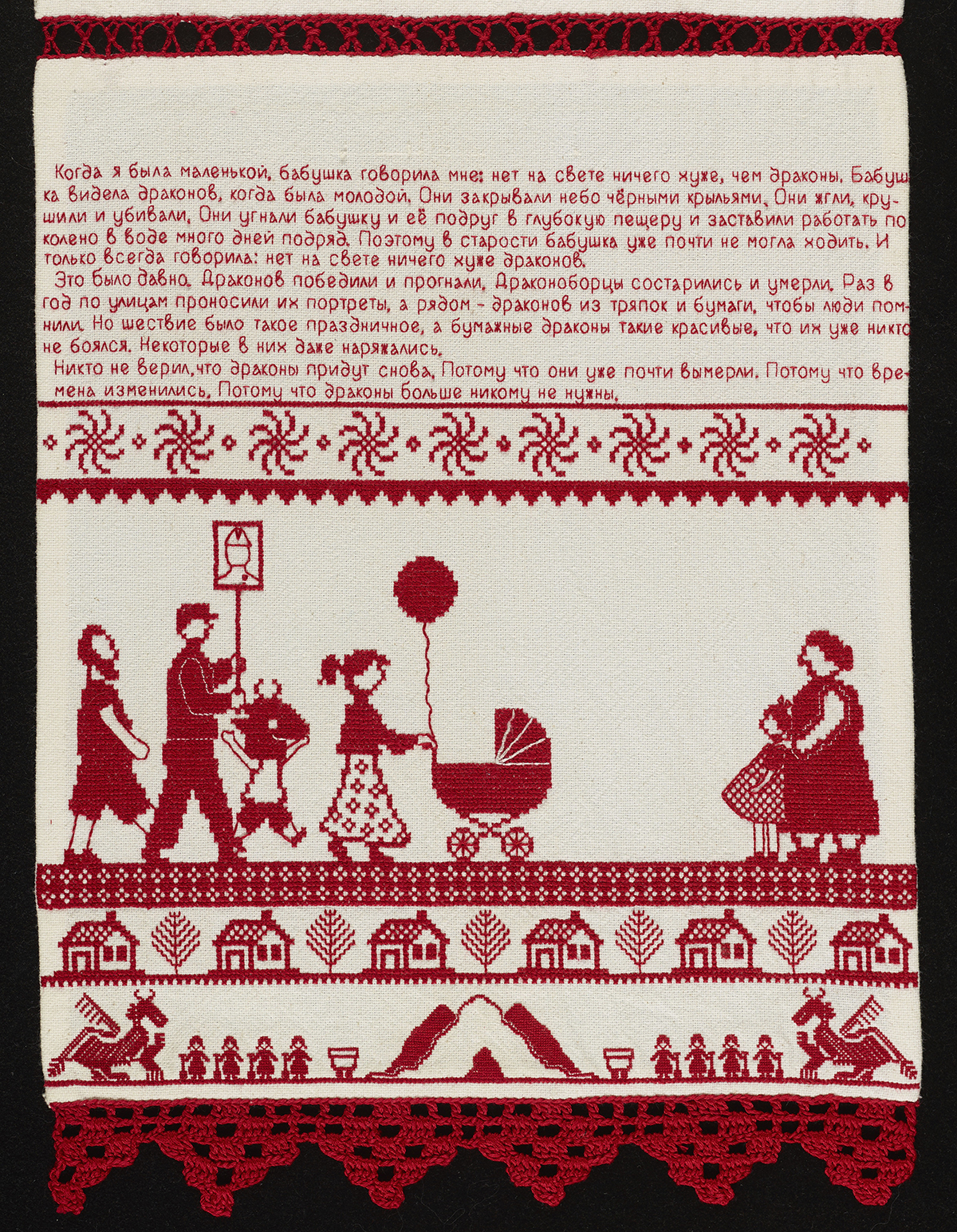
Irina Yushchenko. 2025. When Dragons Came: A Story in Three Rushniks. Embroidery.

When I was a girl, my grandmother would say: dragons are the worst thing ever. She had seen them when she was young. They darkened the sky with their black wings. They burned, they shattered, they killed. They carried my grandmother and her friends off into a deep cave and forced them to work for days on end, standing knee‑deep in water. In old age, she could barely walk. And still, she always repeated: dragons are the worst thing ever.

That was long ago. The dragons were defeated and driven away. The dragon‑slayers grew old and died. Once a year their portraits were paraded through the streets, along with dragons made of cloth and paper, so people would remember. But the procession was so festive, and the paper dragons so beautiful, that no one feared them anymore. Some even dressed up as them.

No one believed the dragons would ever return. Because they had almost died out. Because times had changed. Because no one needed dragons anymore.


Embroidery has existed for as long as needle and thread have. For centuries, women who embroidered have sat in the same posture of humility and obedience: head bowed, eyes cast downward. Embroidery was regarded as a small, feminine task — something both mistress and maid might do after all other, truly important work had been done. Who cares about the pattern emerging under the needle? Only the embroiderer herself, who knows that when she is stitching, no one can see her eyes.

I come from a family in which, as in nearly every Soviet family, many peoples were mixed — but most of all Russians and Ukrainians. Both my Russian and Ukrainian grandmothers kept long white towels embroidered at the ends — rushnyky. These ritual cloths appeared in the pre-Christian era and served as both an imprint of the world and a prayer — first to pagan gods, and later to the Christian one. To this day, any Russian or Ukrainian would recognize them. The rushnyk changed along with society: new patterns emerged, motifs were borrowed — yet its essence remains unchanged: a long white towel whose ends are richly embroidered with red thread.

When the war began, we were all shocked — but that first shock was soon followed by another. It turned out that many people supported the war and those who started it. It was utterly unpredictable, like an illness that anyone could catch, regardless of age, views, or personality. Those who opposed the war were crushed not only by the authorities but by those around them. In a society already steeped in hostility, the habit of denunciation bloomed. And so, when even speaking aloud became dangerous, I began to embroider. I chose the form of the rushnyk precisely because it belongs to both peoples I descend from — Russian and Ukrainian — and therefore to me; it is a heritage no one can take away. 


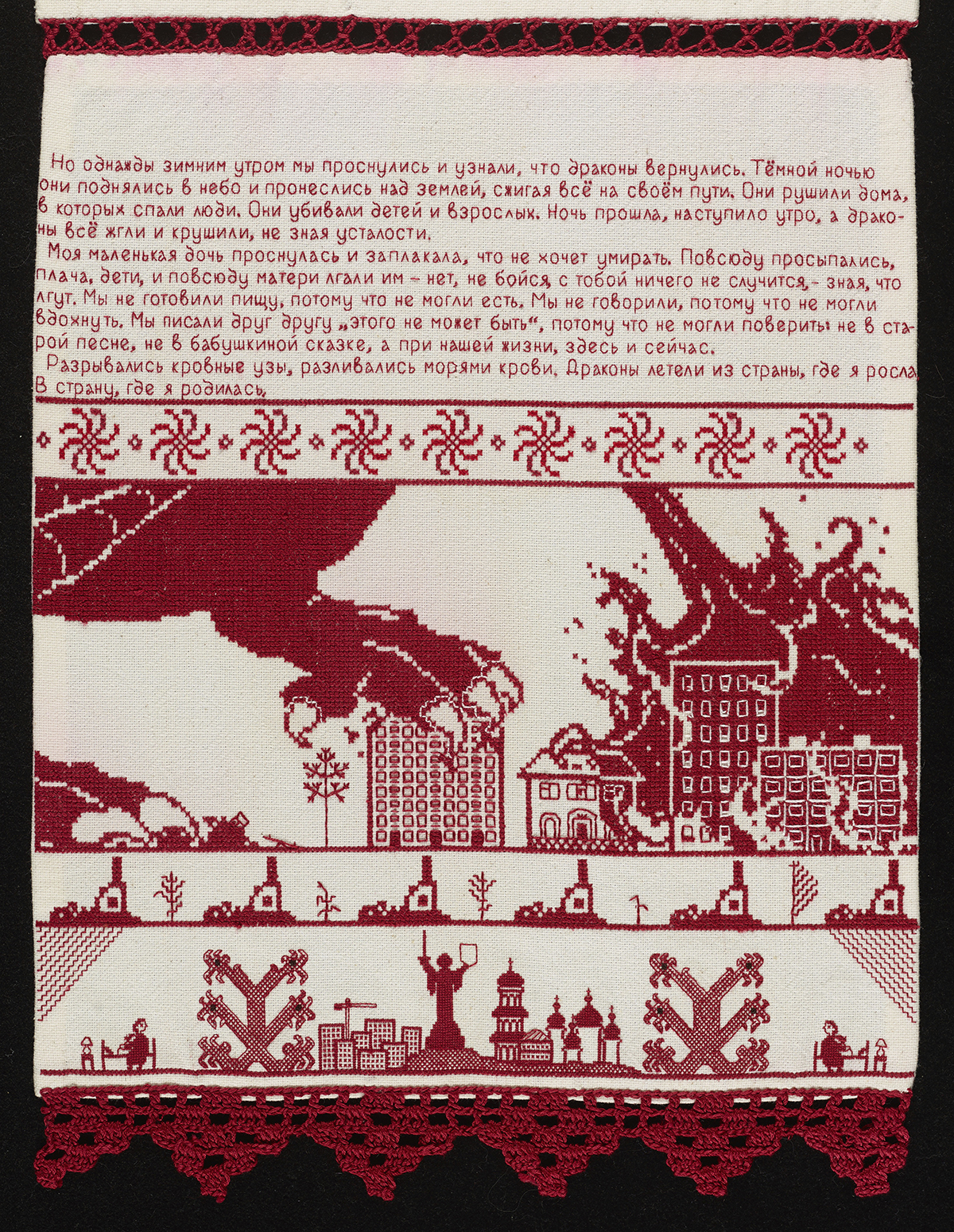
But one winter morning we awoke to learn that the dragons had returned. In the dark of night they had risen into the skies and swept across the land, burning everything in their path. They tore apart houses where people still slept. They killed children and adults alike. The night passed, morning came—but the dragons still burned and crushed without rest.

My little daughter woke and wept that she did not want to die. Everywhere children woke, crying; everywhere mothers lied to them, whispering: don’t be afraid, nothing will happen to you—and all the while they knew they were lying. We did not cook, for no one could eat. We did not speak, for no one could breathe. We wrote to one another: this cannot be happening, because we could not believe it—not in some old song, not in a grandmother’s tale, but in our own lifetime, here and now.

Blood ties were torn apart, seas of blood poured out. The dragons flew from the country where I lived. Into the country where I was born.

The rushnyk is both a symbol of the road and a symbol of human life. Its embroidered ends represent both the beginning and the end of the journey, and at the same time, what lies within a person’s own control. The white center is called “God’s place,” as it stands for the fate written by God. Traditionally, рушники  were supposed to be woven or embroidered from a single piece of cloth to preserve the symbolic continuity of life. However, on these three rushnyks, the ends are cut; I emphasized the line where the fabric was severed with a contrasting red thread, because this war has cut through our notion of a normal life.
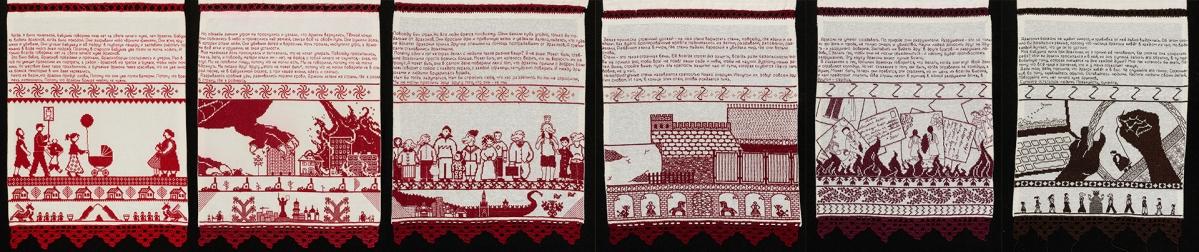
On Slavic rushnyks, you'll find many living beings—people, goddesses, birds, and horses—but almost never a dragon. Dragons appear in Slavic fairy tales, but always as symbols of destruction, disaster, cruelty; it’s no surprise that they are not embroidered on rushnyks. However, the special quality of the rushnyk lies in the way it changed along with life itself: at first it featured protective motifs, then narrative scenes began to appear, and when people moved from villages to cities, there were even scenes of urban life, short texts, and proverbs. I took the next step by adding an element of comic strips or animation to my rushnyks—freeze-frames from real life, but seen through the lens of a grim fairy tale. Additionally, rushnyks are customarily hung, not spread out, so their ends hang side by side and can be read like the pages of a book; this traditional approach here is enhanced by the way the color transitions. If all three rushnyks are viewed together, we see how the story moves from the joyous red of childhood into ever-darkening shades—the darkness thickens, and the solar symbol, the rolling sun beneath the text, grows angular and morphs into the letter Z—the symbol of war adopted in Russia today.

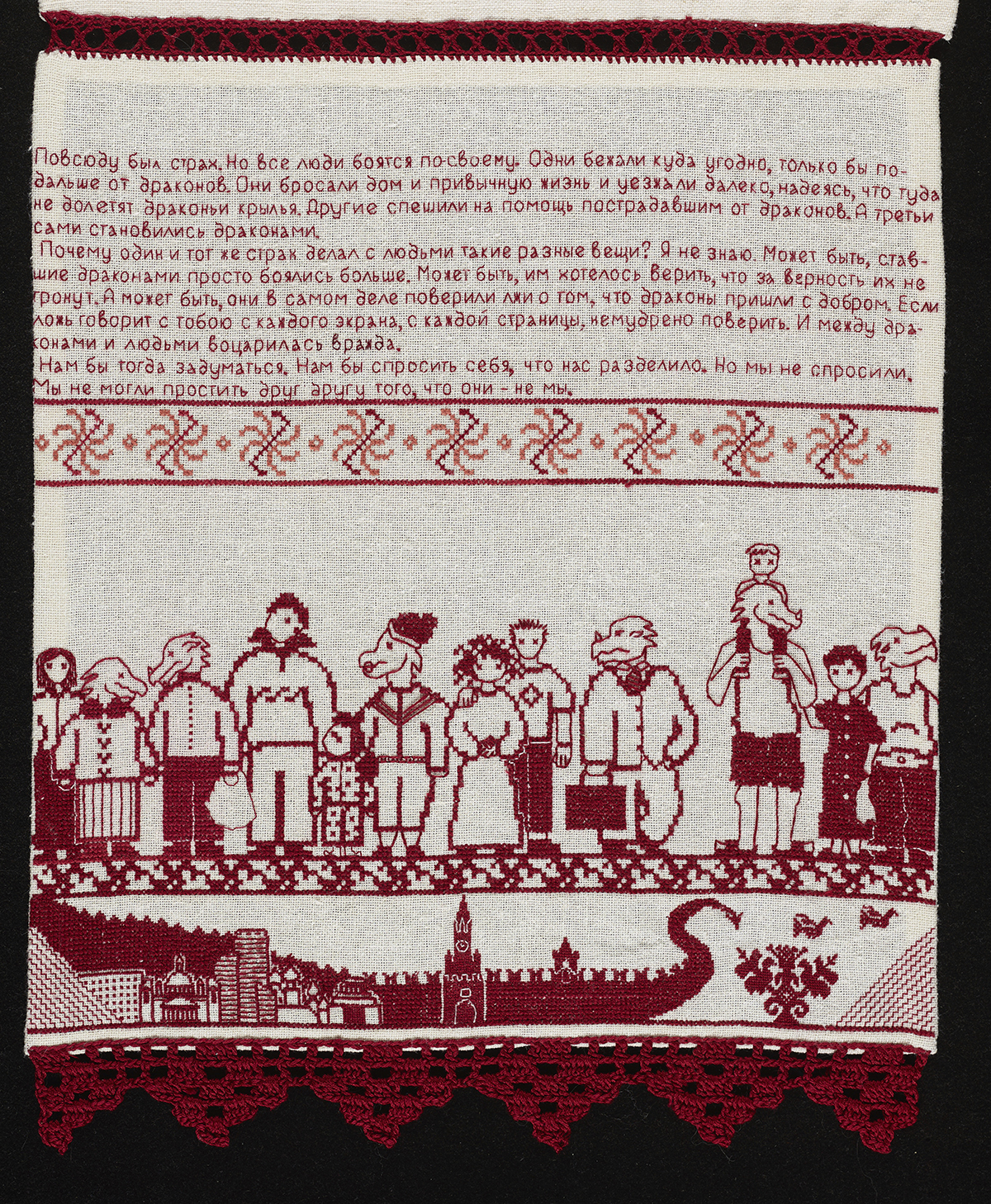
Fear was everywhere. But people fear in different ways. Some fled anywhere at all, so long as it was far from dragons. They abandoned homes and familiar lives, escaping in the hope the dragons’ wings would not reach so far. Others rushed to help those who had suffered at the dragons’ hands. And still others became dragons themselves.

Why did the same fear drive people to such different fates? I don’t know. Perhaps those who became dragons were simply more afraid. Perhaps they wanted to believe that if they were loyal enough, the dragons would spare them. Or perhaps they truly came to believe the lie—that the dragons had come in goodwill. And when a lie stares from every screen, from every page, it is no wonder people believe it. And between dragons and humans enmity took root.


The division of society into pro-war and anti-war camps was completely unpredictable, yet there were clear patterns. Older people supported the war more often than the young; men more often than women; the poor more often than the middle class. It’s not uncommon for family members to hold diametrically opposing views. This division is reflected here: in the symbolic language of the rushnyk, war supporters themselves turn into dragons, their clothing signaling their group or class—the retired, the middle-aged, youth, blue collars. Standing apart is the official, isolated, whom no one approaches and everyone tries to keep at a distance—this reflects the usual attitude toward high-ranking officials, with whom ordinary people prefer not to deal.
Throughout the war, many have been struck by the contrast between tragic events in the wider world and the cheerful, comfortable life continuing in major cities. Economic geographer Natalia Zubarevich cites data showing that, for example, restaurant visits keep increasing, even with soaring inflation. She explains this by saying that, under the weight of pervasive dread, people try to preserve at least the semblance of normal life to protect their sanity. Yet, the dragon’s back grows out of the Kremlin wall and looms in the background of every square, home, and church, no matter how hard people try not to see it.

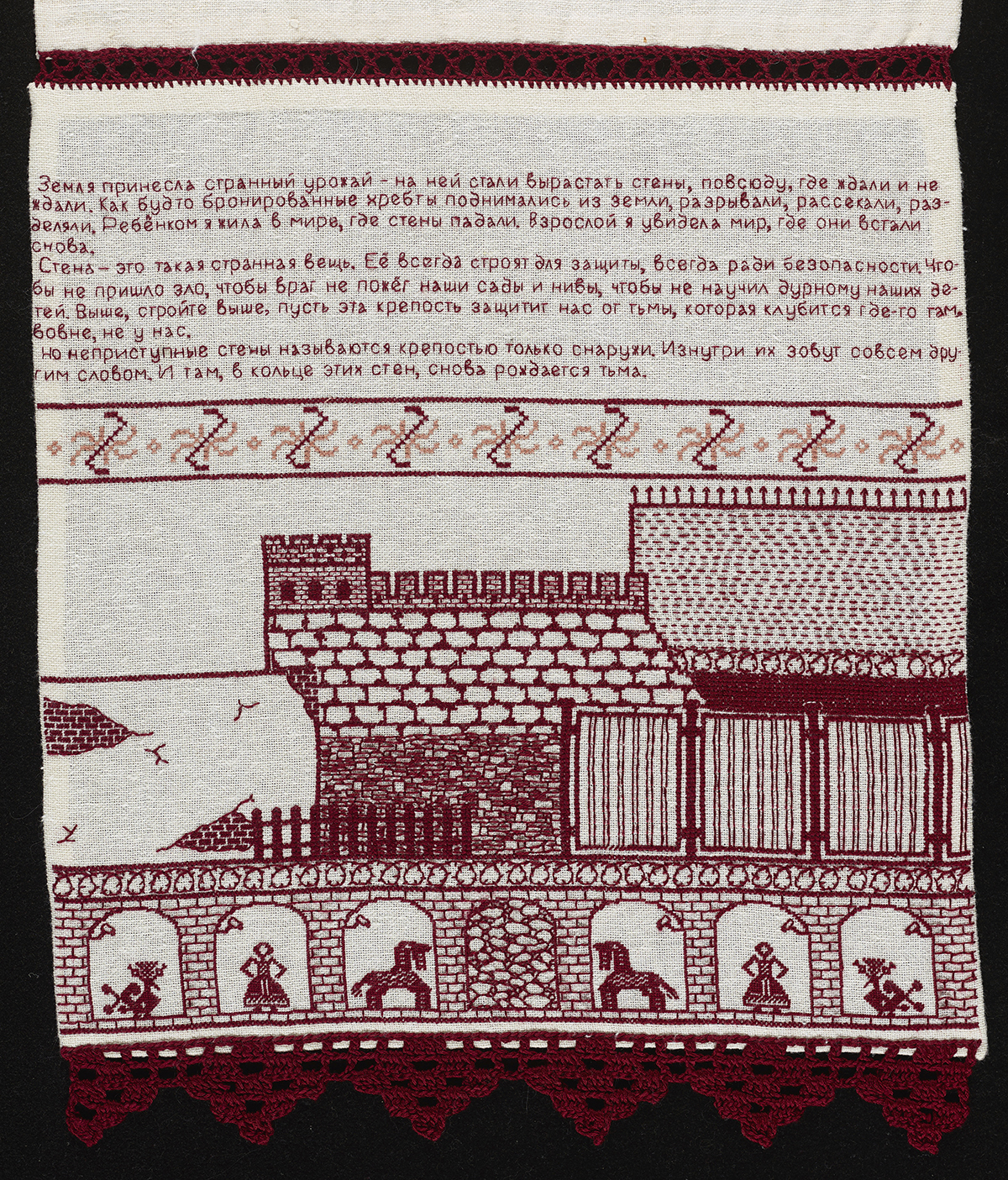
The earth bore a strange harvest—walls began to grow from it, everywhere, expected and unexpected. As though armored ridges surged up from the soil, ripping it open, tearing, dividing. As a child, I lived in a world where walls were falling. As an adult, I saw a world where they rose again.

A wall is a strange thing. It is always built for protection, always for safety. To keep out evil, to keep the enemy from burning our fields and orchards, from corrupting our children. Higher, build them higher, let this fortress shield us from the darkness that churns out there, outside.

But impregnable walls are called a fortress only from the outside. From within, they are given another name entirely. And there, encircled by walls, the darkness is born anew.


It seems to me that the key word of recent years is “disunity.” The events of Crimea in 2014 nearly tore people apart, but society held together then; this war, however, has been too heavy a blow for bonds to survive. Moreover, the authorities have actively encouraged division, pushing the narrative of a besieged fortress and labelling people as “patriots” or “traitors” within the country. The themes of walls, barriers, obstacles have surfaced with increasing frequency not only in national discourse but around the world, and in some places, these walls have actually been built. While embroidering these walls, I made an unpleasant discovery: it turns out that traditional embroidery techniques can be used not only to stitch suns and harvest, but also barbed wire.
As noted earlier, living creatures—birds, horses, human figures (usually women)—have often been embroidered on rushnyks. Typically, they form a unified composition, merging into one another, always moving toward the center, where the primary symbol, the tree of life, usually stands. But in a world of disunity imposed from above, it seemed logical to separate this composition and place the living beings in solitary cells, with the traditional movement toward the center now conveyed by surveillance cameras in each cell.

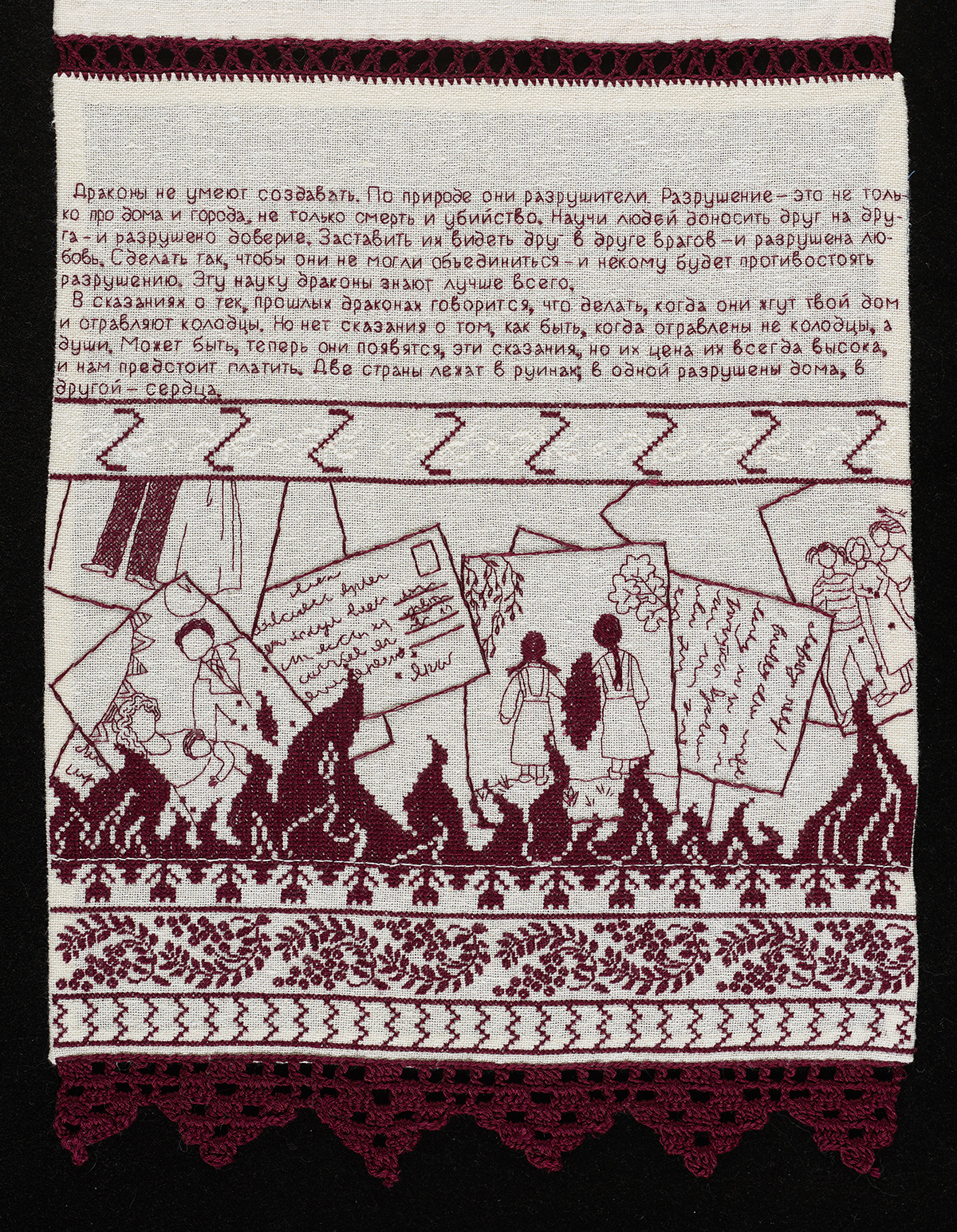
Dragons do not know how to create. By their nature, they are destroyers. Destruction is not only about homes and cities, not only about death and killing. Teach people to inform against one another—and trust is destroyed. Make them see enemies in each other—and love is destroyed. Ensure they cannot unite—and there will be no one left to resist destruction. This is knowledge dragons possess better than anyone.

The old tales of dragons tell what to do when they burn your house and poison your wells. But they do not say what to do when the poisoned wells are no longer in the ground—but in human souls. Perhaps new tales will appear now. But their lessons always come at a terrible price. And it is we who must pay. Two countries lie in ruins: in one, the houses are destroyed; in the other—the souls.


Conveying the theme of rupture and loss proved quite difficult. In traditional Slavic symbolism, every sign of death invariably has a secondary meaning of future rebirth. This is natural for an agrarian culture, where burying grain means a new harvest will sprout. Fortunately, a solution was found in Hungarian embroidery, which in many ways resembles Slavic forms, apparently because the Hungarians originate from Central Asia, with which the Slavs have had long, complex relations. Hungarians see a downward-facing flower as a symbol of death. To heighten this effect, I inverted not just the blossom but the entire flower—now this motif evokes confusion, that initial feeling we experience in the face of loss and death. Below sits the rowan, also a symbol of sorrow and mourning, and angular rain patterns, which in Slavic rites are closely linked with tears and weeping.

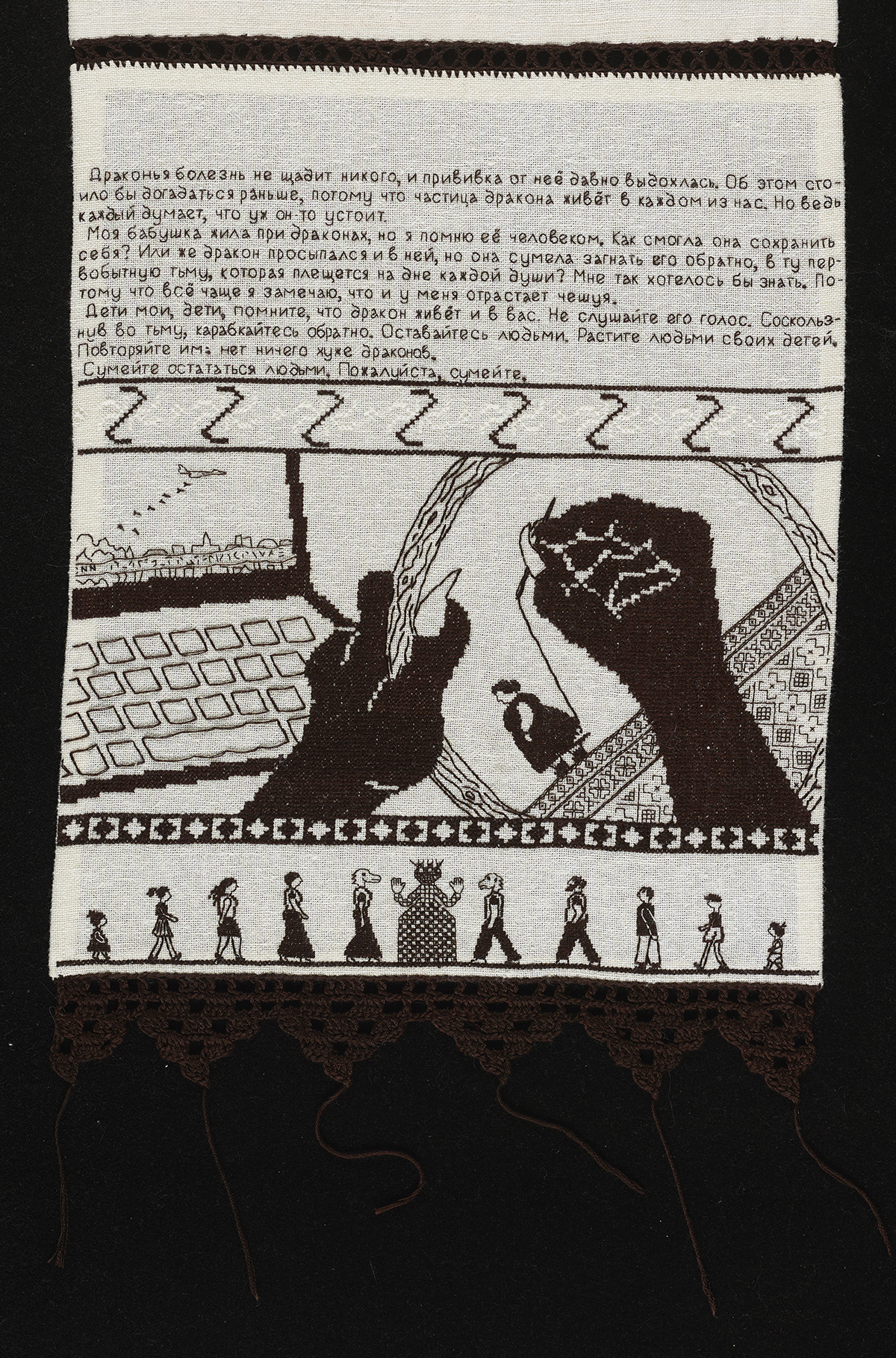
The truth is that the dragon’s sickness spares no one, and the vaccine against it wore off long ago. We ought to have guessed it earlier, for a particle of the dragon lives in each of us. Yet each of us is certain he alone will resist.

My grandmother lived in the time of dragons, but I remember her as a human being. How did she keep herself whole? Perhaps the dragon stirred within her too, but she managed to push it back down, into that primeval darkness lapping at the bottom of every soul. I wish I knew. Because more and more often, I notice scales beginning to grow on myself.

Children, my children—remember this: the dragon lives in you too. Do not listen to its voice. If you slip into the dark, climb back out. Remain human. Raise your children to remain human. Tell them again and again: there is nothing worse than dragons.

Please remain human. Please do.


As mentioned, the images on rushnyks remind me of film stills. There’s a common cinematic solution—in autobiographical storytelling, the final frame steps outside the story and reveals the author, wholly or in part. I depicted what I most often see before me—embroidering hands, but these hands are no longer quite human, because war changes everyone, including those who believe they have remained untouched.
The central element in the bottom border is a female figure with raised, enlarged hands. According to the ethnographer Maslova, a Soviet specialist in rushnyks and ritual embroidery, enlarged hands in these images signify prayer. At the same time, in a modern reading, it can be seen as the gesture for “stop” or “enough.” What is the central figure—the Mother Goddess—doing? Praying that the transformation will cease? Demanding those changing to stop? Or surrendering, powerless? The story doesn’t end with this rushnyk. We don’t know how to end the war and halt all it brings—walls, dragons, fears, and dehumanization. Each person can interpret the gesture made by this figure according to their own understanding.

ABOUT THE AUTHOR

Irina Yushchenko is a self-taught embroiderer and literary translator with over 25 years of experience. In her embroidery, she creates textile narratives that blend historical craft with modern stories of war, family, and resilience. She is based in Leipzig. "When Dragons Came: A Story in Three Rushnyks" was developed by Irina during her artist fellowship within the KonKoop project at the Leibniz Institute for Regional Geography (IfL-Leipzig).