ABOUT THE CASE
The project traces the emotional geography of commemorating Operation Storm in Serbia and Republika Srpska, by mapping the sites of the travelling commemoration and analysing its rituals, speeches, and symbols. The visualisation aims to counter-map the memory landscape constructed through the contemporary politics of remembrance in Serbia, to distinguish how a hierarchy of sites supports narratives of national victimhood and collective identity.
In 2018, during the joint Serbian–Republika Srpska commemoration of the Operation Storm victims, Serbian President Aleksandar Vučić opened his speech with the words:
Today, we have come not only to mark this most dreadful day in our recent history... but also to bear witness before all... that every crime is eternal.
This moment captures the essence of Serbia’s contemporary politics of remembrance — where national victimhood and sacralized suffering become central to collective identity. Operation Storm is remembered not merely as a military defeat or humanitarian tragedy but as a continuation of a historical trajectory of Serbian suffering, linking it to World War II atrocities such as Jasenovac.
Through commemorative rituals, speeches, and symbols, Serbia and Republika Srpska construct a shared emotional geography — a symbolic space where all Serbs belong to one imagined community, regardless of physical borders. This visualization traces that space: the places, actors, and narratives that sustain the idea of a “borderless Serbian nation.”
By mapping ten joint commemorations, it reveals how political discourse transforms memory into a tool of unity and manipulation. Victims are elevated symbolically but neglected institutionally; grief becomes a medium for political messaging; and the boundary between remembrance and irredentism grows ever more blurred.
Sremska Rača 2015
The joint commemorations of the Operation Storm by Serbia and Republika Srpska started in 2015 at the Sremska Rača border crossing, at the symbolic bridge that connects Serbia with RS and was crossed by thousands of Serbian refugees in 1995. The symbolism is echoed in Vučić's speech:
But today, from this very place, we are sending a clear message to the world: that crimes must be forgiven, but they cannot and must not be forgotten [...] and precisely from this place where the Republic of Srpska and the Republic of Serbia are united in pain and sorrow, in a place that 250,000 expelled Serbs crossed.1
In his speech, the bridge at this border symbolizes an interruption of division, allowing Serbs to be united—this time, in grief.
Tanjug News Agency. 2015. Dan sećanja na stradanje i progon Srba u Oluji. YouTube video, August 6, 2015. https://youtu.be/CMked_UzZjM?t=4780.
Busije 2016
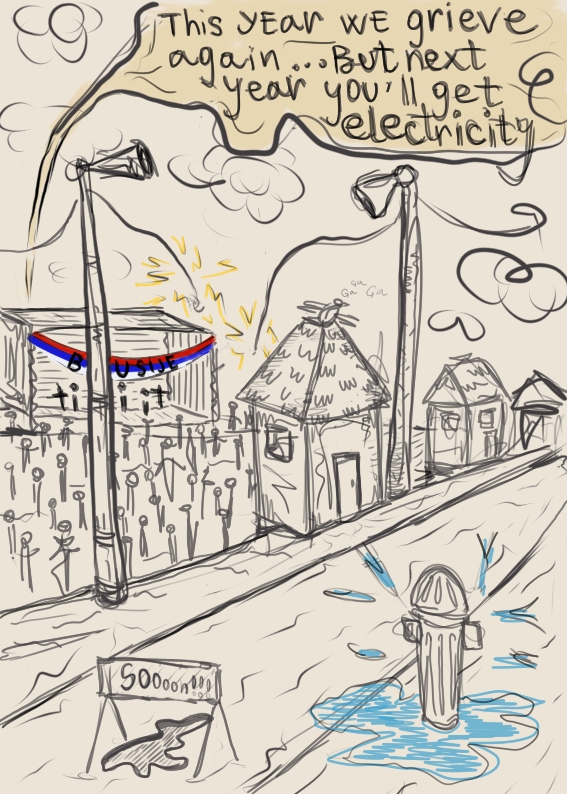
They continued in 2016 in Busije, a small settlement near Belgrade that had gradually grown to around 5,000 inhabitants. In 1995, the area had been nothing more than an empty field belonging to an old, defunct factory, completely undeveloped. During that period, Vojislav Šešelj, Vučić’s former party leader and a war-crime convict, served as mayor of the Zemun municipality in Belgrade. He sold parcels of this land to newcomers despite knowing they had lost all their belongings, were in severe financial distress, and that the area lacked even the most basic infrastructure, such as sewage and electricity.2 Today, Busije, though somewhat improved, still bears marks of infrastructural neglect and financial exploitation.3
U Busijama Obeležavanje Dana Sećanja (Commemoration of Remembrance Day in Busije).” YouTube, August 4, 2016. https://www.youtube.com/watch?v=vBxi-Hw1Er0. ; Santovac, Adam. “N1 ‘Život u Oluji’: Mirko i Nada Vujanić, Busije (N1 ‘Life in the Storm’: Mirko and Nada Vujanić, Busije).” YouTube, August 5, 2016. https://www.youtube.com/watch?v=YP4x6RyIQOg.
Al Jazeera Balkans. 2017. Sjećanja Na ‘Oluju’ u Izbjegličkom Naselju. March 9, 2017. https://balkans.aljazeera.net/news/balkan/2016/8/4/sjecanja-na-oluju-u-izbjeglickom-naselju. ; Santovac, Adam. 2016. Život u Oluji: Mirko i Nada Vujanić, Busije. YouTube video, August 5, 2016. https://www.youtube.com/watch?v=YP4x6RyIQOg.
Veternik 2017
In 2017, the commemoration was held at the football stadium in Veternik settlement in Novi Sad. This was a refugee settlement where many people from Krajina found their peace. At this commemoration, Serbian President Aleksandar Vučić emphasized this continuity of victimhood dating back to WWII:
The people who were slaughtered and killed in camps during the Second World War, who were declared a minority in the early 1990s, and who were further decimated and expelled during Operation Storm, are today in Croatia reduced to the level of a statistical error [...] Out of more than 1,200,000 Serbs who, according to the ethnic map from 1936, lived within the borders of present-day Croatia, exactly 186,000 remain today.4
The chain of verbs—slaughtered, killed, decimated, expelled, reduced—illustrates the omnipresent topoi of threat.
YouTube user “Vojni Invalid.” 2017. Veternik Pomen Žrtvama Zločinačke Akcije Oluja. YouTube video, August 9, 2017. https://youtu.be/BwTN4K0gTis?t=1417.
Bačka Palanka 2018
The year after Veternik, the event was held in Bačka Palanka, a town also populated by people from the Krajina region, who today form a strong local community there, even establishing their own football team called The Wings of Krajina (Krila Krajine)5. The combination of topoi of numbers, threat, and history creates a perception of historical continuity in Serbian suffering, teaching the nation to remain vigilant. A similar pattern appears in Milorad Dodik's 2018 speech in Bačka Palanka, where he referenced not only the historical suffering of Serbs but also their geographic spread6. He linked various WWII atrocities to Operation Storm, describing them as parts of a 'state project' to annihilate the Serbs.
“Krila Krajina Backa Palanka - Club Profile.” Transfermarkt. Accessed March 29, 2025. https://www.transfermarkt.com/krila-Krajina-backa-palanka/startseite/verein/94404.
Ministry of Defense of the Republic of Serbia. 2018. Dan Sećanja Na Sve Stradale i Prognane Srbe u Oružanoj Akciji ‘Oluja’ - Obracanje Predsednika Dodika. YouTube video, August 5, 2018. https://youtu.be/JNPpzhQ8nBQ?t=71.
Krušedol monastery 2019
A slight shift happened in 2019 as the commemoration was held in the courtyard of the Orthodox monastery Krušedol close to Novi Sad. Since the Serbian Orthodox Church (SOC) has been present and a core participant of the commemoration from its beginning it took the responsibility to fully sacralise the event and give it another seconded life in heaven. Krušedol was also an opportunity to amplify anti-Western sentiment, with Dodik portraying the West in his speech as the orchestrator of Serbian suffering during and after Operation Storm:
We must clearly say that they (Croats) were supported, encouraged, and provided with logistical and all other kinds of support by Western powers—above all, the United States, Britain, and Germany [...] That great international community [...] based its entire policy of that time on lies [...] They lied, and based on those lies, they created policies to punish, demonize the Serbs [...].7
Tanjug News Agency. 2019. Uživo, Krušedol - Obeležavanje Dana sećanja na stradale i prognane Srbe u oružanoj akciji ‘Oluja’. YouTube video, August 4, 2019. https://youtu.be/ebw2JMg_ovU.
Sremska Rača 2020
Due to the unfortunate Coronavirus pandemic, the 2020 commemoration was held without the audience, but still in a highly symbolic place, once again at the bridge in Sremska Rača border crossing. The upgraded version of the first commemoration compensated for the absence of the audience with a new initiative materialized in a memorial plaque. After being placed symmetrically on the half of the bridge it was introduced by the event’s host:
For this occasion, the people and the church in the Republic of Serbia and the Republic of Srpska are placing a memorial plaque on which a message will be engraved forever for future generations, a message that will eternally live in the consciousness of all of us.8
“Uživo - Obeležavanje Dana Sećanja Na Sve Stradale i Prognane Srbe u Oružanoj Akciji ‘Oluja’ (Live - Commemoration of the Day of Remembrance of All Serbs Who Died and Were Exiled in the Armed Action ‘Storm’).” YouTube/Tanjug News Agency Official, August 4, 2020. https://youtu.be/dWVuvpZibgw?t=2431.
Busije 2021
In 2021, the commemoration was once again held in Busije. For this occassion, the survivors of the Jasenovac camp— who were children during WWII—were invited to be present but they were not permitted to speak. Instead, they were used symbolically to shift the focus of victimhood entirely onto their suffering, sidelining the victims of Operation Storm. While their names were announced, their agency was erased, highlighting the organizers' instrumental use of symbolic suffering.
Novi Sad 2022
In 2022, the commemoration was moved to the centre of Novi Sad and organized as a big event in front of the town hall. The obvious reason for choosing this location was the amount of people from Krajina that influxed the city from 1995 onwards.9 The event was an opportunity for Milorad Dodik to speak about unity based on shared suffering and the topos of collective victimhood, with explicit calls for state unification:
I have no other identity and nowhere else to turn or go. The only place I want Republic of Srpska to be is within Serbia. Moreover, one day, as a result of all our suffering, our cries, and the losses we have endured, that Serbian national and state unity must come. Moreover, we will see our two states, Republic of Srpska and Serbia, as united in their effort to defend our identity and everything that we are as a people.10
Tanjug News Agency. 2022. Srbija se seća stradalih i prognanih u 'Oluji' – Tišina više nikada neće prekriti zločin.
Prijedor 2023
To avoid repetition, the Serbian and RS officials, together with the Serbian Patriarch Porfirije, decided to switch sides of river Drina and commemorate the victims of Operation Storm in 2023 in Republika Srpska, in the city of Prijedor. This decision was not welcomed by parts of the Serbian public, and civil society organizations, but also by other constitutive people of Bosnia and Herzegovina, Bosniaks and Croats. The reason for the contestation of the location of the 2023 commemoration was mass-scale war crimes committed by the Republika Srpska Army in 1993 against these two ethnic groups in the same town.11 Organizing a commemoration of Operation Storm victims in Prijedor would certainly be more acceptable if the crimes committed by RS Army are not denied, and if the suffering of victims has been fully recognized, as well as responsibility for these crimes honestly embraced by those responsible. Protegee of the politics of denial of crimes in Prijedor is Milorad Dodik, who as the main organizer planned to pour another layer of victimhood into the city’s unfortunate history. Among, the harsh and furious discursive expressions of Dodik, Patriarch Porfirije had more “eclectic” and “pacifist” intentions:
No one has an exclusive, elite, and exceptional right to love their home, their neighbors, their parents, brothers and sisters, their people. No one has an exclusive and exceptional right to the unity of their people, no one has an exclusive, elite and exceptional right to pain, to grief, to mourning their victims, to memories of them and prayers from them.12
Besides mass murders, in the vicinity of Prijedor, the Army of Republika Srpska organized detention camps “Keraterm”, “Omarska”, and "Trnopolje” where many were tortured, suffered diverse mistreatments, and killed.
“Obeležavanje Dana Sećanja Na Stradale i Prognane Srbe u Oružanoj Akciji „Oluja“ – 4. Avgusta 1995. (Commemoration of the Day of Remembrance of the Serbs Who Died and Were Exiled in the Armed Action ‘Storm’ - August 4, 1995.).” YouTube/ALO.RS, August 4, 2023.
Loznica 2024
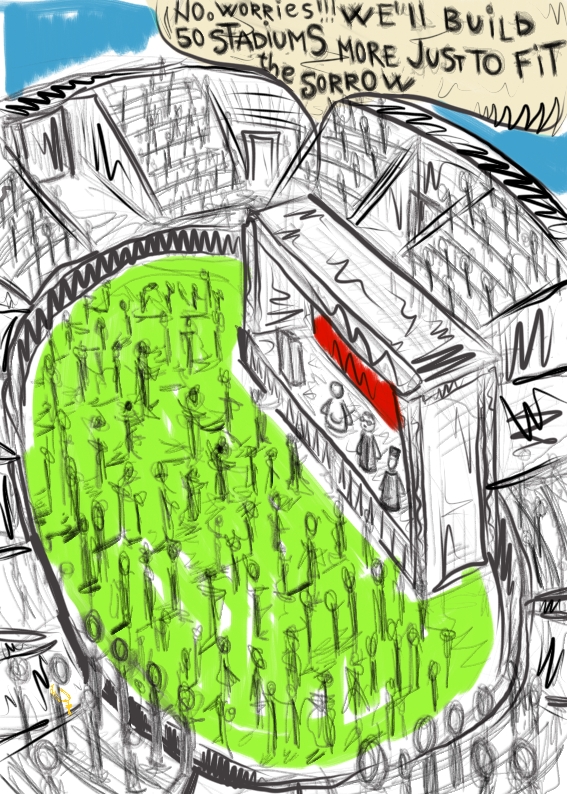
The tenth commemoration reintroduced some discursive repetitions but also introduced a newly chosen location. The commemoration was organized in 2024 at the “Lagator” football stadium in Loznica, a town close to the border with RS. The stadium was ceremonially opened in November 2023 and advertised for years of its construction as an investment of huge national importance. Since there is not a distinctive symbol of Loznica that connects it with Operation Storm, except for its vicinity to RS and slight population descending from Krajina, the question arises, why this location and why this stadium? Both speakers, Dodik and Vučić, connected the location with the modernizing path of Serbia and its trajectory of economic growth. This discursive pattern has been present for years, but it had its specific meaning at the newly constructed football stadium that was opened by the proud President himself:
We will continue to build our country. And I am especially proud that we are here tonight in Loznica because even here at this magnificent stadium you can see how much Serbia has progressed, you can see how much Serbia has changed and will have to change even faster, even more.13
Combining the modernization argument with the location of the commemoration the victims were overshadowed by words and meanings artificially attached to their suffering. The notion of the event changes each time victims lose the focal position at these events, which inevitably shows the intentions of their organizers, and the instrumentalization of their traumas for gaining political leverage.
“3.8.2024. Loznica - Dan Sećanja Na Sve Stradale i Prognane u Oružanoj Akciji ‘Oluja’ (3.8.2024. Loznica - Remembrance Day for All Victims and Exiles in the Armed Action ‘Storm’).” YouTube/Tanjug News Agency Official, August 3, 2024. https://youtu.be/kkg_RbtBolA?t=5202.
Sremski Karlovci 2025
Lastly, the 2025 commemoration marking the 30th anniversary of Operation Storm was held in Sremski Karlovci. For this special occasion the Ministry of Labour, Employment, Veterans and Social Affairs came with a clear reason for choosing Sremski Karlovci as a space for anniversary commemoration. Putting the historical significance of the town before its connectedness to the place with which the victims can relate to, the Ministry indicated that the location has been chosen as:
(...) centuries-old parliamentary seat of the Serbian people and a symbol of spiritual strength and cultural identity, will host the central state commemoration of one of the most tragic pogroms against the Serbian people in recent history.14
Amid ongoing student-led anti-government and anti-corruption protests in Serbia, the event once again downplayed the victims and served as a mobilizing platform for ruling party supporters. Reflecting the polarized political climate, commemorative practices became dispersed: students organized a separate commemoration in Novi Sad, stressing that President Aleksandar Vučić's politicised discourse should not contaminate their remembrance of the tragedy.15 At the same time, two Serbian opposition parties attended a commemoration of Serb victims in Žirovac na Uni, Croatia, staging a mnemonic counter-action that underscored how the ruling elites in Belgrade neglect the victims while politicizing the official commemoration.16
(Uživo) Srbija Obeležava 30 Godina Od Stradanja U Akciji ‘Oluja’ U Sremskim Karlovcima, Obratiće Se Vučić I Patrijarh.” Blic.rs, August 3, 2025. https://www.blic.rs/vesti/politika/uzivo-srbija-obelezava-30-godina-od-stradanja-u-akciji-oluja-u-sremskim-karlovcima/bgjwyd1.
021.rs. 2025. "Studentsko obeležavanje 'Oluje' u Novom Sadu kod Futoške: '30 godina – sećamo se'." 021.rs, August 4, 2025. https://www.021.rs/story/Novi-Sad/Vesti/417112/Studentsko-obelezavanje-Oluje-u-Novom-Sadu-kod-Futoske-30-godina-secamo-se.html
Danas (Jelena Diković). 2025. "„Ni posle 30 godina od etničkog čišćenja Srba u Hrvatskoj rane nisu zacelile“: ZLF i PSG za Danas o zločinima u „Oluji“." Danas, August 4, 2025. https://www.danas.rs/svet/region/zlf-psg-komemoracija-oluja-etnicko-ciscenje/.
Instrumentalising Symbolic Locations
Jasenovac and WWII traumas
Regardless of the location the scenography and the official program are usually set to in dark colours, mostly black. The visuals at the screens shows the convoy of people fleeing Croatia in 1995, but occasionally, and depending from the context they might include the visuals from the WWII period and Jasenovac camp. Therefore, the perception of historical Serbian victimhood has been strengthened, as the footages provoke additional waves of emotions watching the traumatic scenes from the past.
Crossing Drina: Bratoljub Bridge
As previously emphasized, one of the distinguishing features of commemorating the "Operation Storm" victims is that it has been held across two political entities: the Republic of Serbia and Republic of Srpska (RS). Sometimes staged on opposite sides of the Drina River—and twice on the bridge itself—the commemorations symbolically erase the border separating them. Infrastructure projects have reinforced this narrative of unity, notably the "Bratoljub" ("Brotherly Love") bridge, which connects Ljubovija (Serbia) and Bratunac (RS). Merging the towns’ names, it draws from the words brat (brother) and ljubav (love), symbolizing indissoluble ties.17
CZDS. 2019. Stabilokratija / Dodik - Drina Neće Razdvajati Srbe!. YouTube video, January 9, 2019. https://youtu.be/vXCaTiLftbI?t=2694.; Republika.rs.
2021. Kod Bratunca Otvoren ‘Bratoljub’, Most Između BiH i Srbije. November 28, 2021. https://balkans.aljazeera.net/news/balkan/2021/11/28/kod-bratunca-otvoren-most-i-novi-granicni-prelaz-izmedju-bih-i-srbije.
Conclusion
Over the ten years of commemorating victims of “Operation Storm”, the victims once again walked the same traumatic path they had in 1995. In this metamorphic practice of memory politics that lack proper institutionalization and spatial consistency, the victims follow a political will that makes them wander and still remain deprived of a symbolically meaningful site of their traumatic memory. Retracing the same route, victims get retraumatized and prevented from emotionally connecting with the places of remembrance. The extent of absurdity gets higher considering the relations some of the places where commemoration was held have with the “Operation Storm”. Knowing that some do not have any other connection to the event except of a minor population settling there (Bačka Palanka, Loznica) after being permitted to move freely, or came back from the front lines where they were forcefully sent after entering Serbia, or in the specific case of Busije settlement where they struggled with existential and infrastructural problems for thirty years. The fares from being tied to Operation Storm was a commemoration in the courtyard of the Krušedol Monastery in Fruška Gora, being presented as a place close to Novi Sad where a lot of people from Krajina live.
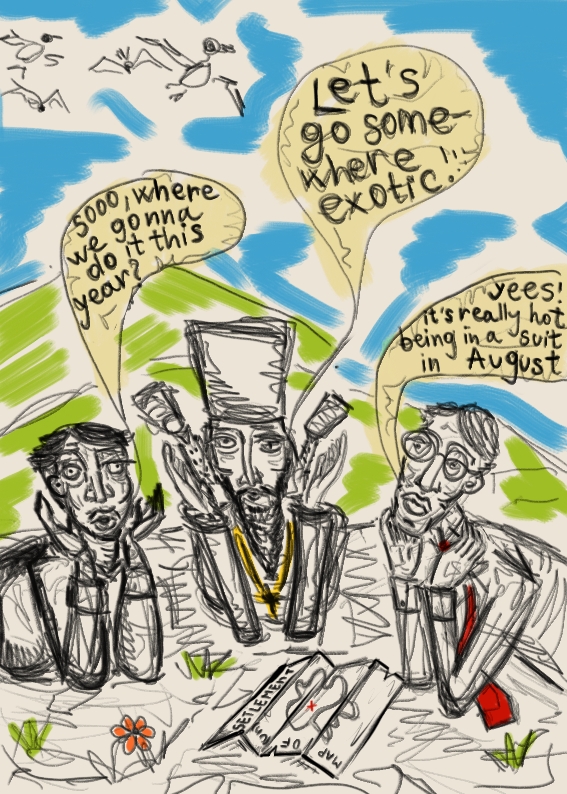
Thirty years after Operation Storm and nearly a decade into its institutionalized commemoration by Serbia and Republic of Srpska, the victims of this traumatic episode remain symbolically central yet materially marginalized. This research demonstrates how commemorative discourse, led by political and religious elites, frames victimhood not as a call for justice or restitution but as a resource for identity-building and political legitimation. Far from fostering reconciliation, the commemorations of Operation Storm risk deepening ethnic cleavages and reinforcing a political culture in which victimhood serves more as a mobilizing symbol than a sensitive status requiring justice, support, and restitution.
ABOUT THE AUTHOR
Since 2022, Nikola Gajić is a PhD-student at IOS. He did his BA in International Relations at the University of Belgrade and holds a MA in Southeast European Studies from the University of Graz and an MA in Nationalism Studies from the Central European University. In September 2020, he joined the Humanitarian Law Center in Belgrade as a researcher at the RECOM project.
Roles
Author: Nikola Gajić
Visualisation concepts: Mela Žuljević and Iaroslav Boretskii
MapBox cartography: Iaroslav Boretskii
Drawings: Nikola Gajić
DataLab: Ivaylo Dinev
Advisor: Jana Moser
1
Mela: Initially, when visualising the original sites of the Operation Storm, we wanted to take up the approach of one visual element representing one life affected. However, as there is uncertainty and conflicting accounts on the number of victims and people displaced, we could not work with exact or certain data.
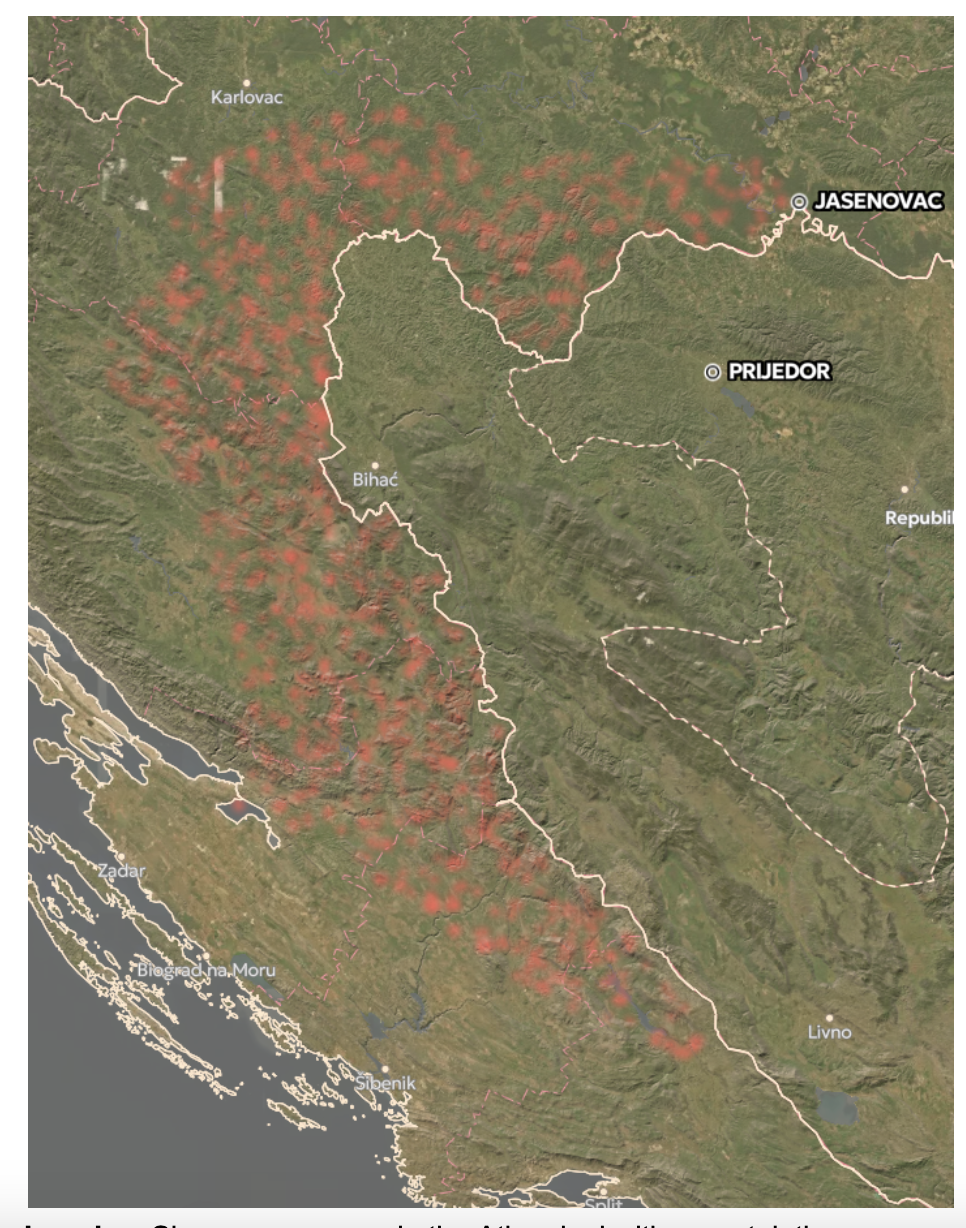
Iaroslav: Since many cases in the Atlas deal with uncertainties, we are repeatedly and inevitably encountering the visualization challenge. For this case, Mela firstly suggested an effective approach of representing an approximate area using abstracted red points that signal the locations where atrocities occurred, therefore representing the victims. Seen from a distance, the map reads as a strong red stain spread across the bordering mountain ranges of Croatia, but as the viewer zooms in, the stain dissolves into individual barely visible dots that quietly reference the victims of Operation Storm. In the end, we integrated a crucial component into the storytelling while avoiding misleading claims of spatial accuracy.
Mela: But in the overall storytelling, it was more important to critically address how narratives of victimhood are represented and how they materialise in space. In addition, we wanted to engage with a multiperspective approach while supporting Nikola in clarifying his positioning in this research. The illustrations introduce Nikola’s personal perspective in this case, a satirical one pointing to the absurdities of manufacturing history and manipulating memory. As someone from the region, I find it important to use visualisation as a tool of articulating our own positions and how we are personally affected by the instrumentalisation of history.
2
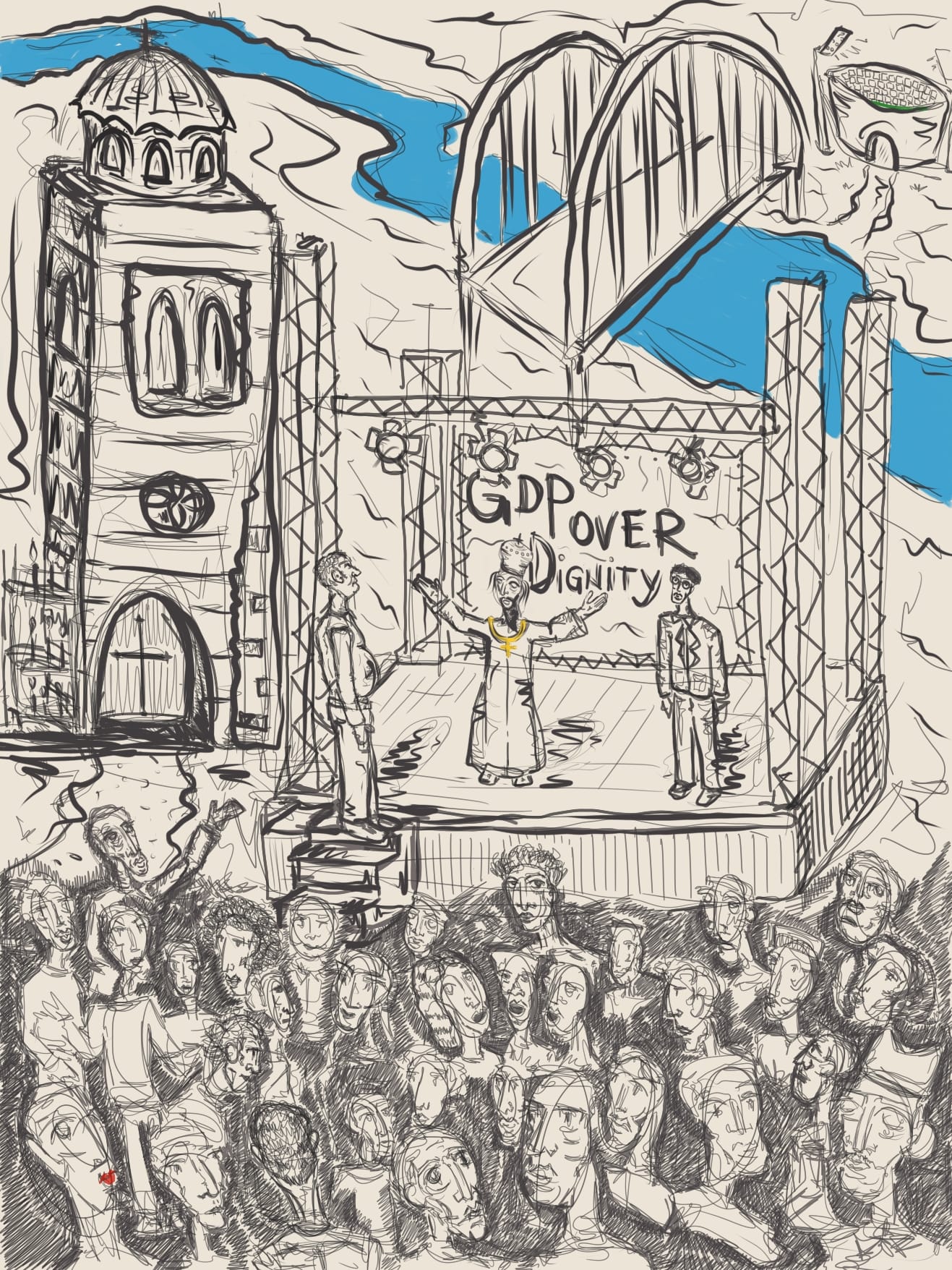
Nikola (Drawing 1: Settling the Unsettled): A dense, distorted collage of sites and people reveals the paradoxical diversity of locations chosen and moments provoked at the annual commemoration of Operation Storm. The traveling nature of this commemorative event colors different places in newly nationalistically mixed, bland tones. The sound of only three male voices floods these sites with mantric content that undergoes only slight changes each year, depending on shifts in the perceived external threat. This drawing, like the following ones, does not focus on the diverse audience for two reasons. First, the impression formed through analysis is that people appear unimportant to the organizers, given the nature of the event, the discourse presented, the symbols employed, and the lack of a pragmatic strategy for vote collection. Second, portraying them in shadow, with distorted faces, or as a homogeneous group reflects my personal sense of how these people are treated at such events. Splashed with raging nationalist discourse and calm sacral vindications, these people become lost in the absurdity of the constructed context — one that leaves them tearful for a few poetic hours, yet unprivileged and disenfranchised for the remainder of the year.
3
Mela: As the sites are often chosen for their scenographic importance and use, we chose the satellite view as a way to enter into the material and the architectural, as we are limited with access to photography of the sites. This has dangers as we see the sites always from above and flying over the terrain as a “God’s view”. However, such a view corresponds with the “travelling commemoration” agenda of landing onto locations, without much care for the context or the victims.
4
Nikola (Drawing 2: Busije — The Paradox of Caring): This drawing represents the double commemorative event held in the Busije settlement near Belgrade. The settlement emerged as part of a masterful plan by Vojislav Šešelj (a former far-right political leader and a convicted war criminal before the ICTY). By selling parcels of land to refugees from Croatia, the municipality of Zemun created a distorted space founded upon vulnerable and tragic memories, memories left unaided by meaningful social or infrastructural support.
Residents of Busije struggled with shortages of water and electricity, the absence of sewage systems, a primary school, and many other essentials that would have signaled genuine care. Despite serving twice as a site of commemoration, Busije did not win the lottery of sustained attention from high-level state organizers. The field in front of the stage filled for a single day, while structural problems remained to be battled in solitude.
5
Nikola (Drawing 3: Stadium Lagator, Loznica — Self-Awarded Penalty Kick): It seems that nationally celebrated infrastructural projects cannot be spared from commemorative practices in Serbia and Republika Srpska. Thus, the newly built Lagator football stadium in Loznica acquired its symbolic charm by hosting a commemoration of Operation Storm victims.
The three principal actors staged a set match against the “evil West,” invoking God as the imagined fair referee. Yet beyond proclamations of national pride, they failed to offer words capable of settling the unease of those who, thirty years later, still await housing and dignified treatment. Instead, the organizers offered finely cut grass, promises of sporting spirit, and finally a self-awarded penalty — seemingly struck into their own goal.
6
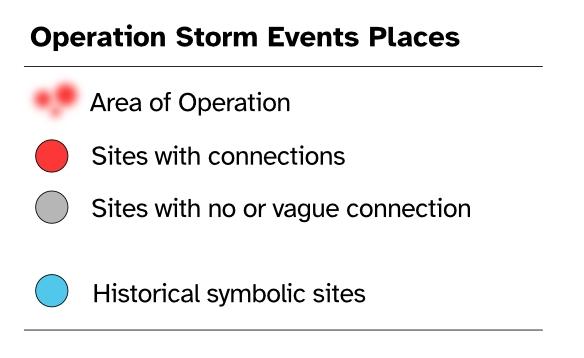
Mela: Finally, it was important for the visualisation to trace the different locations and conclude the story with a map differentiating the complex geography of memorial culture. This is what the last map clarifies in its legend, by distinguishing sites with clear and symbolical connections, as well as those with post hoc manufactured associations to Operation Storm.
7
Nikola (Drawing 4: Location Spinning Wheel Tactic): This drawing depicts the three main actors whose ontology has become inseparably tied to the commemoration. Their logistical and political preferences have set the event in motion year after year since 2015, placing already unsettled victims of Operation Storm on the move once more.
The commemorative path they trace takes shortcuts and veers away from the roads of real events — unlike the very people being commemorated, who in 1995, under police surveillance, were unable to take any turn.