ABOUT THE CASE
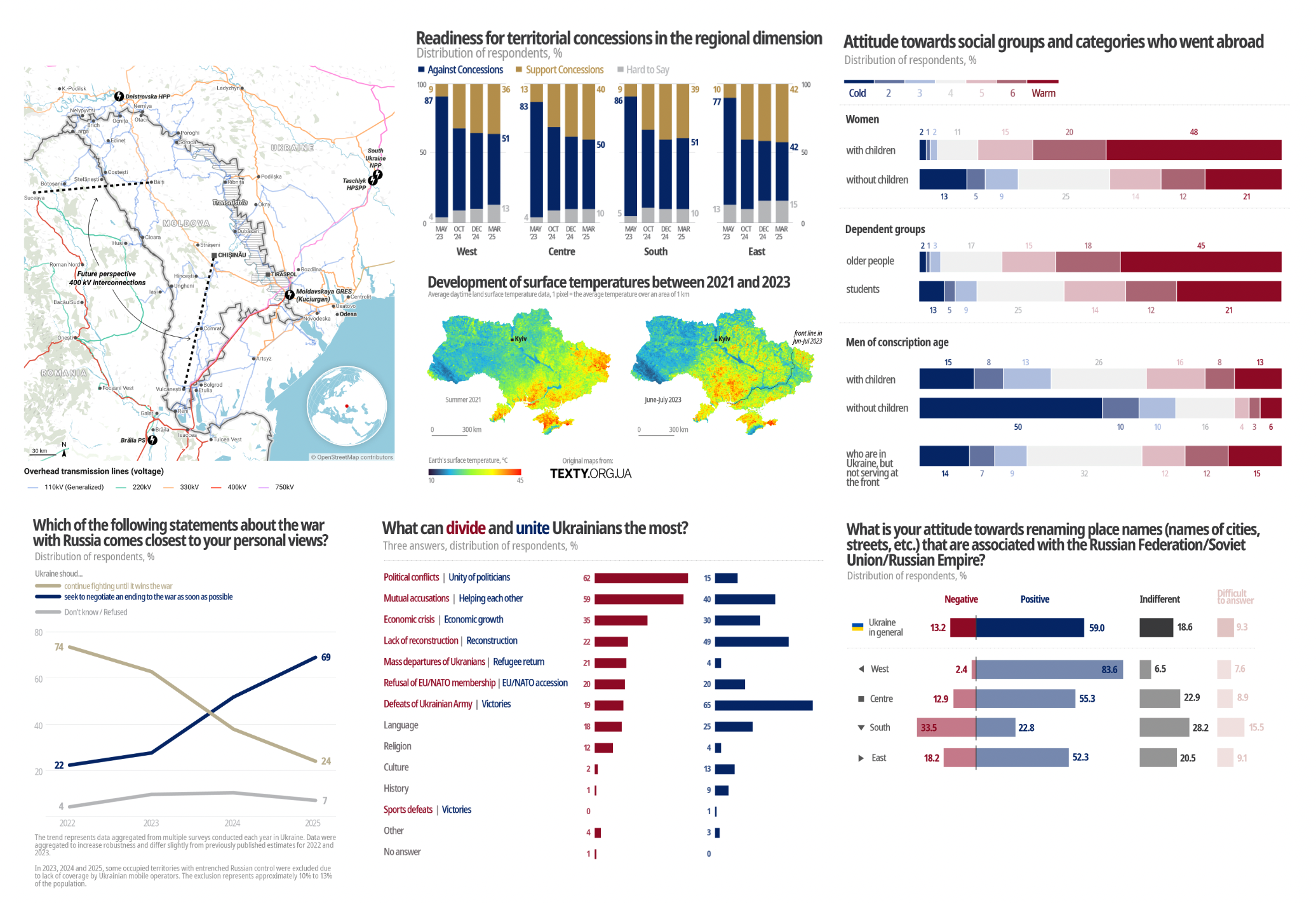
In this visualisation, we highlight the key topic lines and concerns distinguished in the In:Security Report Series edited by the author, Nadja Douglas. By tracing the geography represented in the reports, and drawing icons for specific topics addressed in them, the case outlines a geovisual sketch engaging with the shifts in European security order.
In the context of the Russian war of aggression against Ukraine, security perceptions and discourses in Europe have changed considerably. The KonKoop (research network Conflict and Cooperation in Eastern Europe) thematic line of In:Security in Eastern Europe intends to address different aspects of security and insecurity, relying on critical/vernacular security studies as a theoretical prism. This implies going beyond conventional state-/military-centred notions of security. Instead, the focus will shift to regional/local security demands and needs. The aim is to shed light on how the Russian war and global security developments are perceived and have particular consequences at those levels – in a deliberate decentring of the idea of a European security order.
The following visualization of In:Security Report Series, consisted of multiple contributions divided into four distinctive topics, brings over a concise spatial perspective of collected findings.
Armenia’s Post-War Security Conundrum: Contemplations after the 2020 Nagorno-Karabakh War (Asbed Kotchikian)
Armenia is struggling with Russian interference and the resulting divisions within society. It has been more affected than other countries by Russia’s loss of regulatory power in the region. The current threat to the country’s democratic consolidation process and the stagnating normalisation process in its relations with Azerbaijan do not contribute to an enhanced perception of security either.
The Influx of Russian migrants to Georgia – a factor of insecurity? (Kornely Kakachia)
Georgian society is affected by anxiety. It seeks to gain from but at the same time fears the consequences of an influx of Russian migrants. There is the worry not only that Russia will drive a wedge into Georgian society from the outside, but also that Georgia’s democratic governance will be eroded from the inside.
Finnish security perceptions and the securitisation of borders with Russia (Joni Virkkunen)
Historical memory determines the Finnish population’s altered perception of security since February 2022. Finland’s policy towards Russia has changed from a neutral-pragmatic to an explicitly defensive-oriented one, driven by the population’s desire for more security and certainty. This yielded in in the country’s decision to join NATO and eventually complete border closures.
Paramilitary civil society – remaking defence from below in Poland (Weronika Grzebalska)
The Polish case illustrates the paradigmatic changes in Polish defence since 2014, placing particular emphasis on the process of “remaking defence from below” through paramilitary civil society groups.
Divided Belarusian society and the potential consequences of emerging insecurities (Andrei Kazakevich)
Russia’s war against Ukraine has also further divided the Belarusian society. Although sympathies towards Russia remain, the overwhelming majority of the population is against a direct participation by Belarus in the war. The gap between the authorities and public sentiment has widened as repressions continues since the political crisis of 2020. Threats to societal security are aggravated by the ongoing militarisation of the Belarusian state (stationing of Russian troops and service provider) and the instrumentalization of migration.
Weaponisation and its reverse: Implications for Ukraine’s security (Yuliia Kurnyshova)
Ukraine is at the centre of the Russian war of aggression. Based on the Ukrainian experience, the Russian logic of ‘a weaponisation of everything’ – an extension of war to non-military resources, such as energy, food and the environment – has not only created unprecedented chains of insecurity but also led the Ukrainian society becoming more robust and resilient.
Moldova’s National Security Strategy and societal cohesion (Inna Șupac)
The Moldovan society has been disproportionately affected by the Russian war, especially in terms of social and economic consequences. While their security situation is not comparable to Ukraine, many security risks are imminent and a constant burden for a society that has already had to shoulder longstanding insecurities emanating from a lack of societal cohesion and unity. Societal divisions have deepened, and the polarisation has made the society vulnerable to external interference.
KonKoop In:Security Report Series 1/2024: Old Fears and New Threats: Insecurity and Societal Cohesion in Russia’s Neighbourhood
The full-scale Russian invasion of Ukraine in 2022 has had severe implications for security perceptions, discourses and internal societal dynamics, in particular in countries in the Russian Federation’s immediate vicinity. Viewed in terms of the ‘ontology of security’, the invasion was a paradigmatic rupture for the entire region, which as well as reinforcing longstanding fears, has given rise to new threats and insecurities.
When evaluating the security of countries in Russia’s neighbourhood, policymakers and scholars primarily look at top-down state actions. A new report focuses on security ‘from below’ and finds that societal cohesion is crucial for security in the region. The KonKoop In:Security Report deals with seven countries in three overarching chapters. In their analysis of how each country reacted to Russia’s full-scale invasion of Ukraine in 2022 in terms of their security policies, the authors find considerable variation across the country cases and show how the different discourses and perceptions of security are rooted in the respective histories of these states. While some societies, like Moldova and Armenia, have become more polarised since Russia’s invasion of Ukraine, others, like Finland and Poland, have become more united in face of the new threat situation.
Click to read the In:Security Report Series 1/2024 at KonKoop webpage.
From Dependence to Resilience: Moldova’s Long Road to Energy Security between Russia and the European Energy Grid (Ana Otilia Nuțu)
Moldova’s struggle of emancipating itself from the dependence on network-bound gas and electricity supplies from Russia has been characterised by the issues of affordability and accessibility. This dependency has been mitigated since Moldova has now physical access to alternative sources of energy from the European market.
Ukraine. Living with Energy (In)Security in Times of War (Andrian Prokip)
In the context of an existential risk in Ukraine, the availability of energy, in particular electricity, has outweighed all other dimensions of security. The Ukrainian case shows that energy security should be reprioritised and redefined to take account of the needs of society and local communities in times of conflict and war.
Energy (In)Security in Latvia: Managing Decoupling Under the EU Energy Umbrella (Vineta Kleinberga)
In Latvia heightened perceptions of energy insecurity have increased the risk of compromising environmental sustainability/acceptability. The Russian war against Ukraine has accelerated debates and decisions related to energy security (decoupling of the BRELL network). The energy topic is also instrumentalised to destabilise society through the spread of disinformation by Kremlin loyal forces.
KonKoop In:Security Report 2/2024; Energy Security in Eastern Europe since Decoupling from Russia: The Fragile Balance Between Geopolitics, National Politics and Vernacular Perceptions
Russia’s war against Ukraine exposed the vulnerabilities that come with energy dependence on Russia. For states across Europe, the need to decouple from the Russian energy system was clear. This decoupling process has been especially challenging for Eastern European countries so embedded in Russia’s energy infrastructure. This KonKoop In:Security Report looks at how three Eastern European countries have gone about severing their energy ties to Russia. Moving eastwards from the protection of the European energy umbrella in Latvia to peripheral Moldova and wartime Ukraine, we can see how energy security becomes more precarious. In all three countries energy geopolitics is intertwined with the perceptions and fears of ordinary consumers.
Click to read the In:Security Report Series 2/2024 at KonKoop webpage.
Feminist Security and Defence in Russia’s War on Ukraine (Míla O’Sullivan)
From a feminist perspective, multiple war-induced insecurities have reinforced, as part of Russia’s (ideological) warfare, the global normalisation of anti-gender radicalism. Thus, gender has become a central battlefield between an increasingly illiberal gender order in Russia, and the Ukrainian experience of an emancipatory and liberalising trend with regard to gender discourses.
Decolonial Memory Work as a Response to In:Security in the Context of Russia’s War against Ukraine (Yuliya Yurchuk)
Post-colonial and decolonial discourses have gained momentum in Ukraine since the beginning of the Russian military invasion. While at the official level, decolonisation takes the form of nationalisation, at the grassroots level it is a means of liberation, self-empowerment and adaptation to radical insecurity. Thus, decoloniality has turned into an ongoing process of resistance and a condition for Ukraine’s victory in the war.
Understanding the Environmental Consequences of the War in Ukraine (Oleksiy Vasyliuk)
The effects of the war on human and environmental security in Ukraine is often overlooked in discourses on the war. The damages on landscapes and ecosystems draws attention to the difficulties of post-war reconstruction, notably for the conversion of post-war ecosystems, such as the Kakhovka Reservoir and Velikyi Luh.
Fostering Resilience and Social Cohesion under Occupation (Tetiana Skrypchenko)
In the context of societal responses to the war and the strengthening of societal cohesion in a society under occupation resilience plays an important role. Recent survey data among the Ukrainian civilian population and military personnel provides insights into the well-being of the most vulnerable social-demographic groups in Ukraine, which have had to cope with increased levels of stress and insecurity. The war prompted a remarkable surge in cohesion, which is interrelated with resilience. A resilient society is more likely to sustain cohesion, but weak cohesion can make it harder to stay resilient.
KonKoop In:Security Report 1/2025: Emancipatory Dimensions of In:Security – Strategies of Coping with War Challenges in Ukraine
Russia’s war of aggression has not only caused appalling atrocities and terrible destruction in Ukraine; it has also set back societal progress and security in various domains, including gender and social equality, historical justice and self-perception, societal cohesion and environmental protection. These dimensions of in:security have been widely overlooked in ongoing discourses with their emphasis on hard security issues.
The present report summarises the results of the third In:Security Workshop held online on 16 October 2024 on ‘Emancipatory Dimensions of In:Security’ as part of KonKoop’s topic line ‘In:Security’. The topic line investigates how security is perceived, experienced and enacted by ordinary citizens and how ‘societal security’ in Europe has transformed in the context of Russia’s war in Ukraine. The workshop was dedicated to the feminist, post-/de-colonial, ecological and societal dimensions of security and insecurity. Participants focused mainly on the Ukrainian case, but also drew comparisons to the situation in wider Eastern Europe. The purpose of the workshop was to pool expertise and enhance interdisciplinary exchange among the participants. This report is based on the exploratory research presented at the workshop by experts from Ukraine and the Czech Republic who then elaborated on the overarching question of how in:security has evolved and partly led to emancipatory/liberating attitudes and effects.
Click to read the In:Security Report Series 1/2025 at KonKoop webpage.
Moldova: Countering Insecurities by Leveraging Geopolitics (Denis Cenusa)
The current situation of in:security in the Republic of Moldova is determined by several factors, among them the situation in the Russian-influenced breakaway region of Transnistria, the implications of former energy dependencies, political corruption and democratic backsliding, as well as societal polarisation and external interference by Russia via disinformation. The decision to enter the EU accession process remains Moldova’s most important security asset and ticket to becoming part of an emerging European security architecture.
The Future of European Security – Ukrainian Perspective(s) (Yevgeniya Gaber)
Ukrainian perspective(s) on the war and the future of European security dispel any illusions about a quick peace. Instead, reliance on military and economic strength, deterrence, security guarantees from outside powers, and accountability for war crimes and justice should guarantee a sustainable peace. Ukraine should be a key actor and asset in any new European security context.
Public Attitudes in Ukraine and Russia Towards the War and European Security (Alexandra Dienes and Simon Weiß)
The text focuses on public attitudes towards Russia’s war in Ukraine and European security in Ukraine and Russia. Opinion data from both countries are the basis for an analysis of the convergences and divergences in Ukrainian and Russian public opinion on perceptions of victory and acceptable concessions.
Societal Views on an Emerging European Security Actor – the View from Poland (Magdalena Jakubowska and Anna Kuczyńska)
Poland as a frontline state plays a pivotal role in any possible future European security arrangements. Therefore, the country is currently redefining its role within the European and global security framework, with Polish stability depending on a strong military, allied cooperation and economic independence.
Prerequisites and Tools for Facilitating a New Peace and Security Order in Europe (Simon Weiß)
This contributions illustrates what is needed to construct a new and more stable European security order by sketching the most obvious preconditions. Among them is the need to preserve diplomatic channels with Russia open in order to avoid unintended incidents and escalation. The ‘Peace Matrix’ as a heuristic tool entails a ‘sequenced pathway’ to eventually achieving peace in Ukraine.
KonKoop In:Security Report 2/2025: Perspectives on European Security: From Below and In Between
The external threat emanating from Russia has eroded the sense of certainty and predictability that individuals and states need to feel safe and secure in their identity – a phenomenon captured by the term ‘ontological security’. The fourth and final KonKoop In:Security report focuses on this dimension of security with case studies from three of the most war-affected countries: Ukraine, Moldova and Poland. In Europe’s currently fragmented security architecture, the inherent security interests of the states caught between NATO and Russia have been oversimplified and partly disregarded. The authors of the report argue that in the shift to a more functional European security order, greater consideration must be given to the security perceptions and needs of these societies.
The report summarises the results of the workshop on ‘Vision(s) of Post-war European Security’ held at ZOiS on 22 January 2025 as part of KonKoop’s In:Security topic line The topic line aims to question state-centric notions of security and insecurity in times of war and conflict. The workshop was an endeavour to brainstorm about different perspectives on European security by scrutinising how decisions on the European/geopolitical level resonate on the ground. Participants emphasised the regional and local levels, with a focus on security perceptions and visions from below and in between.
Click to read the In:Security Report Series 2/2025 at KonKoop webpage.
AFTERWORD
Security remains a multifaceted and complex phenomenon. Once the fighting in Ukraine comes to an end, the different sides will require political imagination, strategic patience and institutional innovation to find a new mode of peaceful coexistence. And they would be well advised to listen to the opinions of their respective populations, in Ukraine and Russia in particular, where perceptions of victory and acceptable concessions still diverge widely. But they should also listen to the ‘in-between’/non-aligned states that have been badly affected by the war of aggression in Ukraine and geopolitical polarisation. The security issues, threats and challenges each of them faces are very different. The European North-East (a region in the making) and the states constituting this region have been shaken in their ontological security and have developed a new security consciousness that departs to some extent from the security objectives and the strategic culture of restraint of Western European states. Their primary security concern is to prevent a Russian victory in Ukraine and thereby curtail Russia’s imperial ambitions. These perspectives also need to be taken into account in order not to create a breeding ground for further internal disagreements among European allies. Aligning security interests and perceptions as well as defining Russia’s role in European Security and relations will become important tasks in the future. Finally, the growing polarisation in Europe has not only affected the security order and security institutions like the EU, NATO and the OSCE, but also left unaligned countries in a position where their inherent security interests have been oversimplified and partly disregarded. Avenues and entry points for further research on diverging security perceptions in Europe would include or address the root causes of security-political regional polarisation. A viable regional setting for these states remains an important element of European security in the future.
SELECTED BIBLIOGRAPHY
Barry Buzan, Ole Wæver, and Jaap de Wilde, Security: A New Framework for Analysis (Boulder, CO: Lynne Rienner, 1998).
Soumita Basu and João Nunes, ‘Security as emancipation,’ In: Critical Approaches to Security An introduction to theories and methods, edited by Laura Shepherd (Abingdon, Oxon, New York: Routledge, 2013).
Kenneth Booth, ‘Security and Emancipation’, Review of International Studies, 17(4), 1991: 313-326.
Karen Fierke, Critical Theory, Security and Emancipation. International Studies Association Compendium Project, 2009.
Denis Cenusa, ‘Russia’s hybrid warfare on EU enlargement’, The Loop, ECPR’s Political Science Blog, 2025, https://theloop.ecpr.eu/
Thomas E. Graham, ’Getting Russia Right’, 2023, Cambridge, UK: Polity Press.
Tereza Hendl, Olga Burlyuk, Míla O’Sullivan, and Aizada Arystanbek, ‘(En)Countering Epistemic Imperialism: A Critique of ‘Westsplaining’ and Coloniality in Dominant Debates on Russia’s Invasion of Ukraine, Contemporary Security Policy Vol. 45:2, (2024): 171–209.
Judith Herman, Truth and Repair: How Trauma Survivors Envision Justice. Basic Books, 2023.
Lee Jarvis and Michael Lister, ‘Vernacular Securities and their Study: A Qualitative Analysis and Research Agenda’, International Relations 27(2), (2013).
Kornely Kakachia and Salome Kandelaki, ‘The Russian Migration to Georgia: Threats or Opportunities’, 19 December 2022, PONARS Eurasia, Link.
Christos Katsioulis, Walter Kemp and Simon Weiß, ‘Conversations on European Security. Peace Matrix, Friedrich Ebert Foundation / Geneva Centre for Security Policy, February 2025, https://peace.fes.de/
Vineta Kleinberga et al., CLINAP: From Indifference to Making Difference in Climate Policy: Improving the Interaction Between Political Narrative and Societal Perceptions in Latvia, (Project, Rīga Stradiņš University, 2021–2023), https://science.rsu.lv/en/
Asbed Kotchikian, ‘Armenia Elections: Democracy and Security on the Ballot’, 15 June 2021, Aljazeera, Link.
Kratochvíl, Petr and Míla O’Sullivan, ‘A War Like No Other: Russia’s Invasion of Ukraine as a War on Gender Order’, European Security, Vol. 32:3, (2023): 347-366.
Michael LaBelle, Energy Cultures. Technology, Justice, and Geopolitics in Eastern Europe (Cheltenham, UK & Northampton, MA, USA: Edward Elgar Publishing, 2020.
Sophie Lambroschini, ‘How Do Ukrainian Networks Resist? Sources and Limits of Critical Infrastructure Resilience’, PONAR policy memos #816, IERES, George Washington University, 12 December 2022, https://www.ponarseurasia.org/
Stuart Lau, ‘We told you so! How the West didn’t listen to the countries that know Russia best’, Politico, 9 March 2022, Link.
Ana Otilia Nuțu and Sorin Ionota, ‘Energy, Russian Influence and Democratic Backsliding in CEE’, Expert Forum (May 2017), https://expertforum.ro/en/
Míla O’Sullivan, ‘Women, Peace and Security as Deterrence? NATO and Russia’s War against Ukraine’, International Affairs, Vol. 100:2, (2024): 549–568.
Darya Tsymbalyuk, Ecocide in Ukraine: The Environmental Cost of Russia’s War. John Wiley & Sons, 2025.
Oleksiy Vasyliuk, Danger! Mines! The terrible environmental and human cost of Ukraine’s minefields, Ukraine War Environmental Consequences Work Group, 18 November 2024, https://uwecworkgroup.info/
Yuliya Yurchuk and Kateryna Zarembo, ‘The Human Face of Ukrainian Resilience’, in: A World Order in Transformation?, edited by Ninna Mörner (Centre for Baltic and East European Studies, Södertörn University, 2024).
Nick Vaughan-Willams (2021), Vernacular Border Security: Citizens’ Narratives of Europe’s ‘Migration Crisis’ (Oxford: Oxford University Press, 2021).
Margarita Zavadskaya, ‘The War-Induced Exodus from Russia: A Security Problem or a Convenient Political Bogey?’, 29 March 2023, Finnish Institute of International Affairs, Link.
ABOUT THE AUTHOR
Nadja Douglas (Reports Editor) is a political scientist and researcher at ZOiS, where she coordinates the KonKoop topic line ‘In:Security in Eastern Europe’. She is currently engaged in a project at the German Institute for International and Security Affairs (SWP) investigating the role of the Organization for Security and Co-operation in Europe (OSCE) in an evolving European security order. Nadja holds a Master’s degree in International Relations from Sciences Po Paris and a PhD from Humboldt University Berlin.
Roles
Author: Nadja Douglas
Visualisation concepts: Iaroslav Boretskii
Cartography: Iaroslav Boretskii
DataLab: Ivaylo Dinev
Advisor: Mela Zuljevic and Jana Moser
Nadja: As the editor of the reports, I was primarily focused on the text itself in the early stages. But I quickly became aware of the added value provided by the graphics and visuals that Iaroslav created for each individual report. Thus, I was immediately thrilled about the idea of the Atlas project. We are fortunate to have such accomplished experts in cartography and visual communication as Mela, and graphic designers like Iaroslav, on board to translate all our “text work.” Over the past few years, this “translation work” has become a unique selling point for KonKoop within the framework of Vislabs. Throughout the various stages of the Atlas’s development, I’ve come to realise just how much more complex and multi-layered conflict dynamics and security perceptions become when they’re presented visually and cartographically.
Iaroslav: My involvement in the In:Security in Eastern Europe case was somewhat deeper than in the other cases, as I had already been involved in the production of the reports over several years as an infographic designer. Alongside visualising data and materials provided by researchers, part of my work involved developing additional graphics that could help communicate and uncover specific dimensions of insecurity addressed in each report. I therefore approached the Atlas not only through its methods and thematic focus, but also as an opportunity to experiment with different formats and approaches to visualisation.
Since a substantial number of visuals had already been produced for contributions, my initial idea was to move away from increasingly common digital and AI-based approaches to cartography and return to a more tangible experience of map-making. Primarily this was an aftermath of my short talk with Dr. Jana Moser in December 2024 when we were discussing the influence of GIS software’ default settings on eventual map design; so Mrs. Moser’s well-said argument on “having a pencil and paper could be good enough to start making a map” left in my mind for some longer time. It felt interesting to give this approach a chance in order to diversify the visual methods for the Atlas as well.
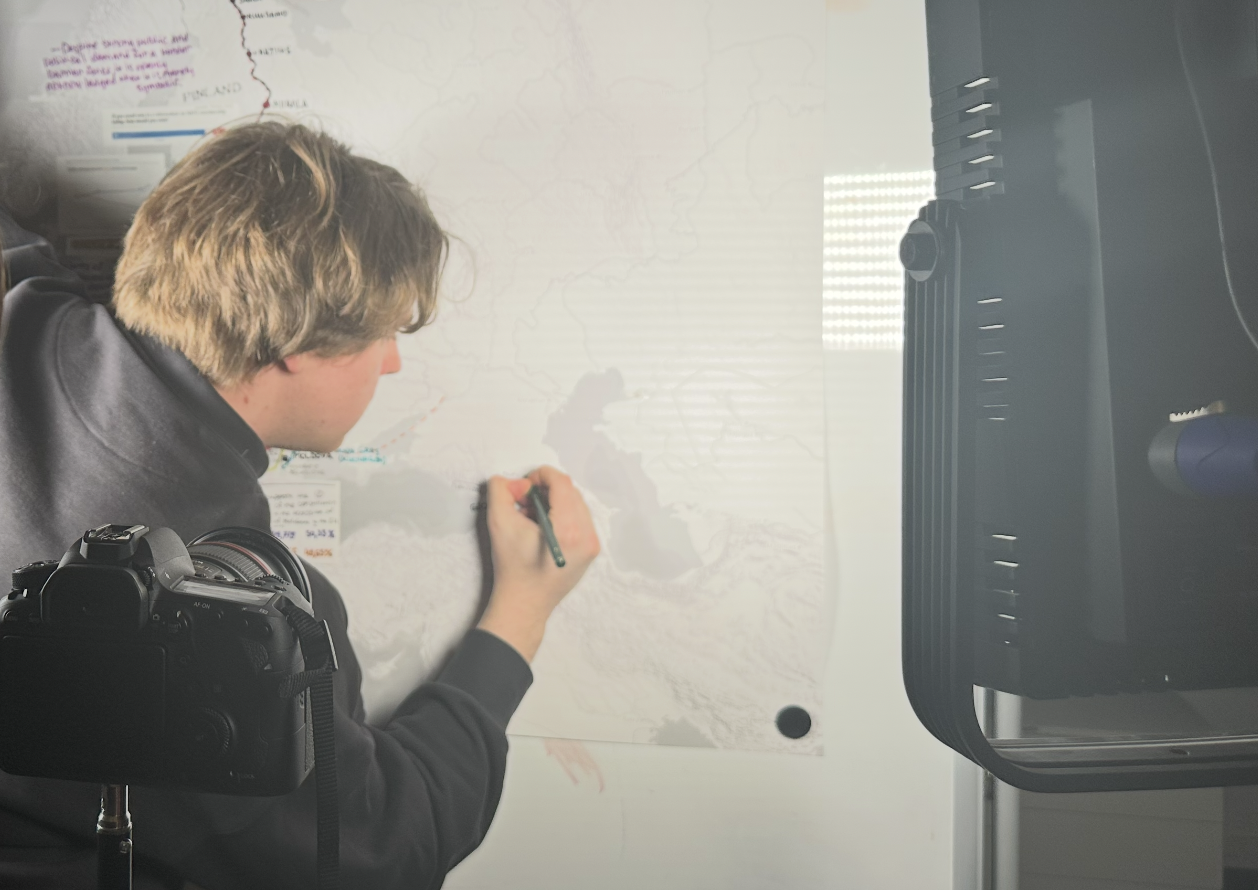
I decided it would be great to experiment with a stop-motion animation, bringing together a base map with overlaid printed and hand-drawn layers. The idea implied to have all contributions being somehow thematically displayed over the territory of Europe, though having rather non-versatile data structures and phenomena overlapping each other. I produced a somewhat initial draft using this approach:
https://visualisingconflictpeace.de/files/default/media/video/2026-09/map-3.mp4
However, the available time and resources, alongside my work on the other Atlas cases, made it rather complicated to develop this approach to the level I had envisioned. More importantly, the experiment revealed a broader visual challenge where with more than a dozen contributions and different perspectives on insecurity, the layers quickly began to overlap, making it difficult to find a clear visual language within the conventional geographical space of a map of Europe. Stop-motion also introduced a certain linearity into the storytelling, which did not necessarily correspond well to the multiplicity of perspectives represented by the project.
Although the experiment was not developed into the final output, it was useful for understanding these contextual limitations. This definitely could become a great technique for another case in the future. But following this exploration, I decided to return to a predominantly digital format.
The final map was therefore designed as an SVG-based interactive container, using a background map connected to the Atlas’ backend.
Mela: One important motivation for using such a SVG map to visualise this case was the need to compare the different reports and how they represent the space of Eastern Europe through different security-related questions. For this reason, I liked the initial icons that Iaroslav designed, which stretched across the map as they reflected geographies described in specific texts (e.g. energy networks or border-zones). However, as not each case had such a geographic dimension, it was difficult to maintain a uniform approach for all of the icons. I did not find this to be a big issue and I suggested Iaroslav keep the “expanding” icons but to consider carefully where the non-geographic icons are positioned. Here I proposed to arrange them in a grid way so that they don’t imply they are tied to a specific location. While keeping all the reports visible at once might create a complex image, I appreciate Iaroslav’s decision to keep them transparently visible at 10% when one of the layers is selected. This allows still noticing the extent and connections even when not all cases are clearly shown.
Iaroslav: Rather than trying to display every contribution simultaneously, the reports are introduced through interactive semi-transparent layers, shortened descriptions, and icons that communicate some of their initial meaning. This allows users to explore individual contributions and gradually discover what lies behind each report, while retaining the geographical context of the overall project.
Several iterations were necessary to find an appropriate balance between the map and its interactive elements. One of the remaining limitations is the side-peek module: when opened, it covers a significant portion of the map, although it’s primarily Russia’s territory. A tooltip-based solution could potentially preserve more of the geographical context.
Nevertheless, I find the current version more intuitive and effective than the initially planned approach. It combines functionality with an exploratory dimension and, rather than imposing a linear narrative, gives users more freedom to navigate between the different perspectives on insecurity represented in the project.