Maps of Division and Environmental Conflicts in Bosnia and Herzegovina

ABOUT THE CASE

This project traces the uses of maps in dividing Bosnia and Herzegovina to visualise how these maps influenced the vision of land as ethnic property and military terrain during the peace talks. We engage with critical and counter-mapping to articulate the long-term legacies of the Dayton Peace Agreement in the environment and their connection with current environmental conflicts.

The 1990s war in Bosnia and Herzegovina was qualified as map-driven: it witnessed cycles of violence influenced by maps of ethnic distribution, land possession and territorial claims. The participants in the peace envisioned the future territorial division of the country while describing portions of its land as ‘empty’, ‘important’, ‘worthless’ or ‘theoretical’. 

Peace agreement maps rarely saw land as anything other than ethnic property or military terrain. This “peace cartography” was a violent process of seeing the land from above to render it into an abstraction, removed from the complex spatial reality of Bosnia and Herzegovina. Legacies of violence remain with the division line that was drawn in finalising the Dayton Peace Agreement, which cut through cities, streets and houses—but also water and landscapes. Based on archival research and analysis of maps from the war in Bosnia and Herzegovina, as well as narrative accounts, media analysis and interviews, this project traces some of these landscape legacies of dividing Bosnia and Herzegovina with maps. 


Illustration based on a map drawn by Croatian wartime president Tuđman in 1995, representing his idea of dividing Bosnia and Herzegovina.

Introduction

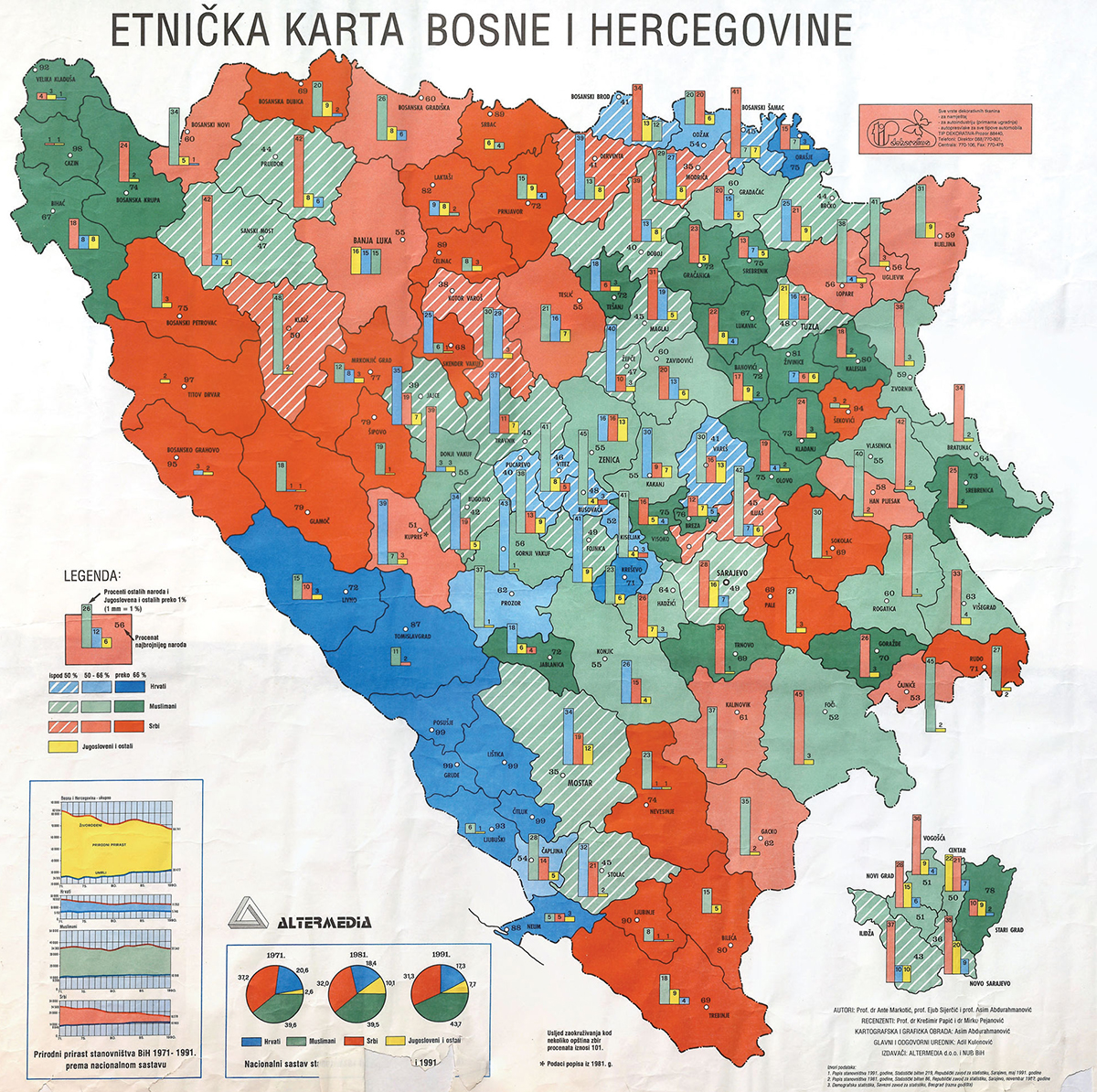
Ethnic Map of BiH (Markotić et al., 1991). Image credits: Bosniak Institute - Adil Zulfikarpašić.
Ethnic majority map produced in 1998 by the International Management Group. Image credits: Bosniak Institute - Adil Zulfikarpašić.
Screenshot taken from the WPSU‘s Geospatial Revolution series, Episode 3, on the use of Powerscene technology during the Dayton peace agreement talks. Used with permission.
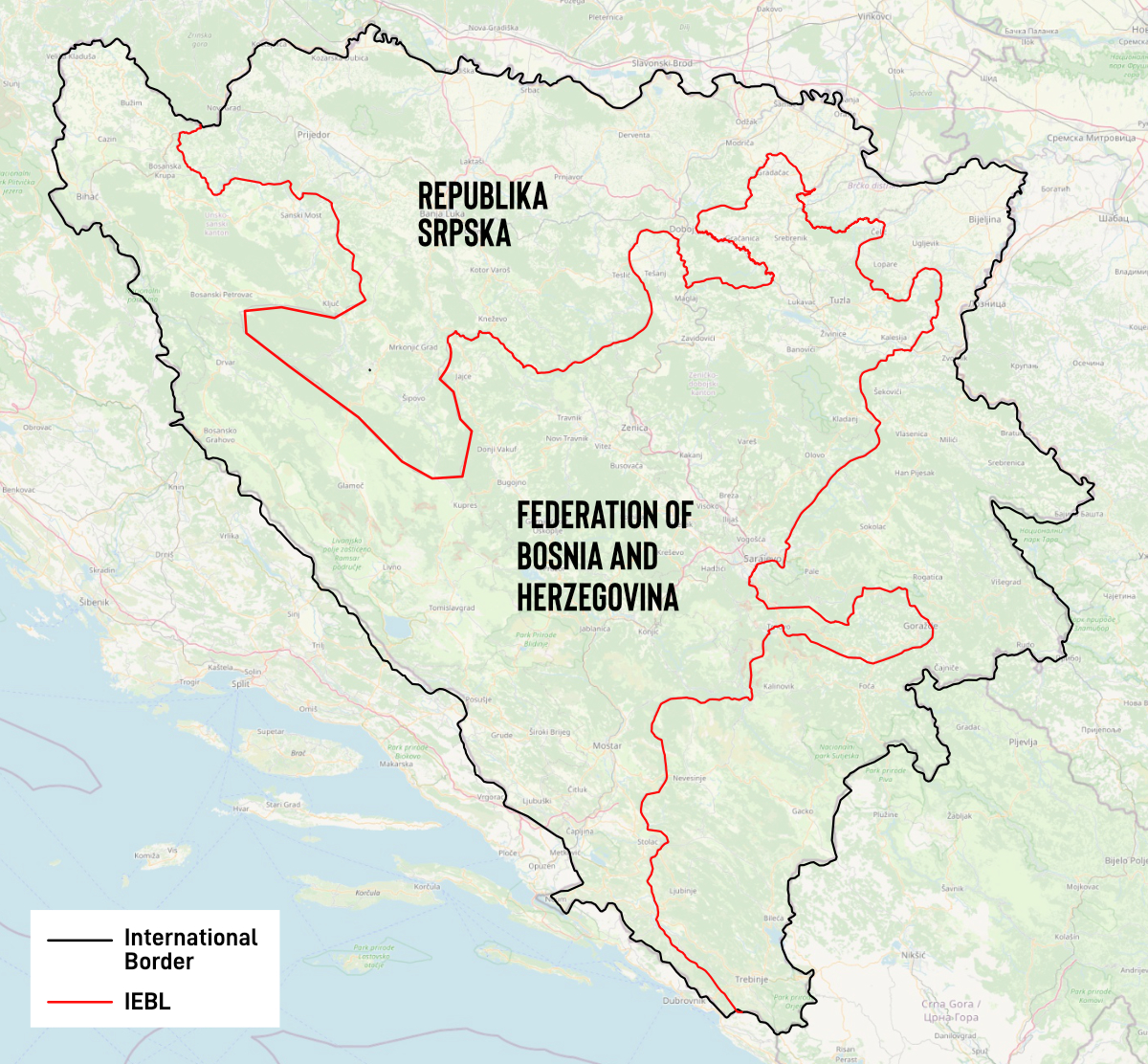
Territorial division of BiH in Dayton. Map by Mela Žuljević.

The war in BiH started in 1992 after this country proclaimed independence from Yugoslavia and the ensuing aggression by the Yugoslav National Army under the control of Serbian ethno-nationalist elites. This led to a series of violent conflicts and war that was qualified as map-driven. Maps were continuously used by conflict parties and international negotiators to claim territory, to document military control, or to divide the country on paper. Mapmaking also preceded the conflict as different parties1 produced competing visions of ethnic distribution in former Yugoslavia to indicate their desired territorial claims. The multiethnic complexity of the country was somewhat evident in the official 1991 ethnic map, so-called ‘leopard skin’ map, which visualised the demographic composition in a more contextualised, detailed and complex way.

1

This included delegations representing the interests of BiH and those representing alliances of Croat-Bosnian Croat and FR Yugoslavia-Bosnian Serb delegations. The composition of international delegations changed across the different peace talks, with EU members leading the initial peace talks (e.g. Vance-Owen and Contact Group proposal) and the US taking over in the final stages. The BiH official delegation was mainly designated by the international negotiators as ‘Bosnian Muslim’, but at most talks it included a more multiethnic representation of the country. See detailed chronologies of different peace talks aspects in Begić 1998, Cruickshanks 2022, Komšić 2013, and Klemenčić 1994.

The maps created afterwards, during the war and in the postwar period, increasingly diminished the representation of multiethnicity (e.g. a high percentage of mixed marriages and families in urban areas) by visualising three majority ethnicities as homogenised groups with the choropleth method2.

2

Choropleth maps are used dominantly and widely even though this model is characterised by multiple limitations (Crampton 2009, 29) such as those of neglecting variations in population density between different bounded areas, e.g. municipalities.

During the peace negotiations in Dayton in 1995, the US negotiating team introduced a new software for delineating terrain, called Powerscene. It was supposed to produce a precise three-dimensional terrain simulation which would help draw territorial division lines in high detail. In retrospect, numerous US participants spoke with enthusiasm of this software and its supposedly objective approach to visualising territory3. Its 3D simulation was so detailed that the participants could even see the streets and houses in which their families lived. But this visualisation also affected how participants saw land as empty, worthless or valuable, leading to specific decisions on how to divide it (more below).

3

See e.g. the accounts of Holbrooke 1998 and Chollet 2007 where they discuss the power of this software to bring the emotions of the local parties under control. They claimed how Powerscene afforded precision in the delineation of territory, it also made the local participants aware (and intimidated) by the spatial intelligence possessed by the US (Branch 2017, Crampton 1996, see also PBS WPSU’s show Geospatial Revolution, ep. 3 on YouTube). While the US-centric narratives of Powerscene claim an enamoration with this technology in all local participants, it is difficult to find any mention of it in the accounts and writings by members of the BiH delegation. This begs the question of how important Powerscene really was for closing the agreement, or how much it was glorified retrospectively to justify the division as technologically devised.

In the fall of 1995, peace in BiH was finally brokered in the city of Dayton, Ohio with the Dayton Peace Agreement (DPA). The Inter-Entity Boundary Line (IEBL, entitetska linija) was drawn to divide the country by establishing two entities, the “Federation of Bosnia and Herzegovina” (FBiH) and the “Republika Srpska” (RS). The drawing of the IEBL followed ethnic and military criteria. The imposition of these criteria over the complex spatial reality of BiH meant the line would need to cut through cities, villages, streets–in some areas, straight through the houses of people. But it also cut through landscapes, forests, mountains, rivers, lakes and other uninhabited land, often described as worthless during the negotiations.

1

This included delegations representing the interests of BiH and those representing alliances of Croat-Bosnian Croat and FR Yugoslavia-Bosnian Serb delegations. The composition of international delegations changed across the different peace talks, with EU members leading the initial peace talks (e.g. Vance-Owen and Contact Group proposal) and the US taking over in the final stages. The BiH official delegation was mainly designated by the international negotiators as ‘Bosnian Muslim’, but at most talks it included a more multiethnic representation of the country. See detailed chronologies of different peace talks aspects in Begić 1998, Cruickshanks 2022, Komšić 2013, and Klemenčić 1994.

2

Choropleth maps are used dominantly and widely even though this model is characterised by multiple limitations (Crampton 2009, 29) such as those of neglecting variations in population density between different bounded areas, e.g. municipalities.

3

See e.g. the accounts of Holbrooke 1998 and Chollet 2007 where they discuss the power of this software to bring the emotions of the local parties under control. They claimed how Powerscene afforded precision in the delineation of territory, it also made the local participants aware (and intimidated) by the spatial intelligence possessed by the US (Branch 2017, Crampton 1996, see also PBS WPSU’s show Geospatial Revolution, ep. 3 on YouTube). While the US-centric narratives of Powerscene claim an enamoration with this technology in all local participants, it is difficult to find any mention of it in the accounts and writings by members of the BiH delegation. This begs the question of how important Powerscene really was for closing the agreement, or how much it was glorified retrospectively to justify the division as technologically devised.

51:49 Pragmatic Absurdities of Dayton

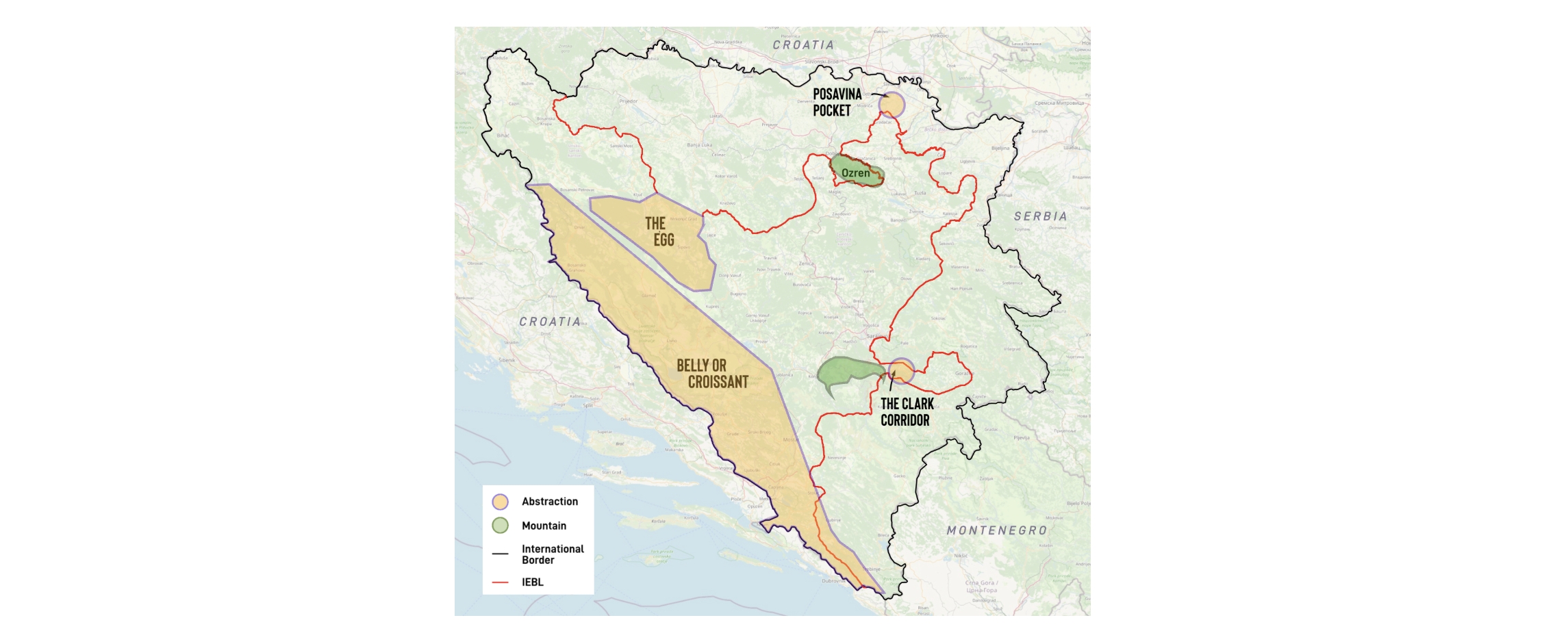
Territorial division of BiH in Dayton with the ratio 51:49. Map by Mela Žuljević.

The peace proposal maps rendered the land in BiH divisible by visualising it as ethnic ownership or military terrain. The use of maps shaped how participants in the negotiations saw swaths of inhabited land as important for being owned by specific ethnic groups, while describing uninhabited areas as empty or worthless. At one point, they agreed to the ethnic division of land in the ratio of 51% for the Bosniak and Bosnian-Croat part and 49% for the Bosnian Serb part.

This ratio of 51:494 was formalised in the negotiations led by the Contact Group in 1994, and it provided a calculative goal that would moderate negotiations and motivate the exchange of occupied land. What followed across negotiations, and up to the Dayton Peace Accords, was a struggle to meet this ratio as the situation on the ground was continuously changing through military action. In scoping the land to find percentages and reach the 51:49 ratio, paper maps and Powerscene visualisation affected how parts of the land were exchanged and divided in relation to their perceived value.

4

The ratio marked a moment of turning away from the idea of dividing BiH in three ethnic units, towards a model that proposed the union between Bosniaks and Bosnian Croats in a multiethnic unit. The percentage was based on a previous Milošević-Tuđman allocation deal which “became the basis for the territorial partition eventually agreed upon at the Dayton negotiations in November 1995. Rather than a three-way split, the divide was 51:49 since American coercive diplomacy over the intervening two years had changed the terms of a possible cartographic fix in Bosnia-Herzegovina” (Toal & Dahlman 2012, 154). The precise ratio was discussed across different peace plans as a tactic of producing a “more coherent map” (Toal and Dahlman 2012, 154) which would make the negotiation goals seem tangible and simple.

(Holbrooke) suddenly realized that there was hardly anything on the screen to see—no houses or villages, just mountains and rocks. He pointed this out to the two leaders.
“That’s right,” Bulatović said, “but that is Bosnia.”

Holbrooke put his head in his hands. “This is going to ruin my marriage, ruin my life. Look at what you’re fighting for. There’s nothing there.”

(…) Milošević ran into Bildt in the parking lot and begged him to keep trying to get the Serbs their 49 percent: “Give me something— hills, rocks, swamps, anything will do. It doesn’t matter anymore.”

From The End of American Century: What the life of Richard Holbrooke tells us about the decay of Pax Americana, George Packer (The Atlantic).

Terrain simulation representation similar to the one of Powerscene.
Click on the visualisation to interact

This map reveals some of the absurdities and abstractions of land which emerged during the final rounds of negotiations in Dayton. These statements exemplify the US-centric narrative of exchanging land with the help of maps and terrain visualisation. They are also reflective of the pragmatic approach to dividing land with ad hoc and simplified solutions in searching for a ‘cartographic fix’ (Toal and Dahlman 20025) that would resolve the war in BiH. Cartographic vision and technology contributed to specific ways of qualifying land - at times as ‘something’, ‘anything’ or ‘nothing’, at others as ‘worthless’, ‘theoretical’, ‘egg’- shaped, or a ‘croissant’. Click on the map to learn more about these abstractions.

These qualifications abstracted land in diplomatic circles as they strived to find a pragmatic and viable solution to dividing the territory of BiH, neglecting its complex spatial reality and distracting from the violence that was undertaken to undo its plurality. Cartography served as an aid to this process and a decoy to represent ad hoc solutions as based on highly sophisticated scientific and technological expertise.


5

Toal, Gerard, and Carl T. Dahlman. 2011. Bosnia Remade: Ethnic Cleansing and Its Reversal. Oxford University Press.

CLARK CORRIDOR

""(...) every detail of the area between Sarajevo and Goražde. The road, the hydroelectric plants, the destroyed mosques, the small village along the road where General Mladić came from - all were discussed with passion and anger”. (Holbrooke 1998, 2816)

Milosevic had offered the Bosnians a thin two-mile road corridor to connect Sarajevo to Gorazde, which, as Clark’s PowerScene tour of the mountainous terrain revealed, was completely unviable. After two hours and a bottle of Scotch (of which Milosevic consumed four glasses), they reached an agreement on a wider corridor through the mountainous terrain. “We have found our road,” Milosevic pronounced. Because of the circumstances surrounding this event, many began to call this agreement, suitably, as the “Scotch Road” or the “Clark Corridor.” Although Holbrooke deliberately downplayed this as a “minor concession”—and dismissed the influence that alcohol might have had over Milosevic’s decisionmaking— it did represent the first substantial breakthrough on a key issue in days. The American team hoped that it might be the first crack in the dam blocking a final settlement. (Chollet 20077)

6

Holbrooke, Richard. 1998. To End a War. Random House Publishing Group.

7

Chollet, Derek. 2007. The Road to the Dayton Accords: A Study of American Statecraft. Palgrave Macmillan.

MOUNTAINS AS SACRIFICES:
Ozren and Bjelašnica

In the last rounds of territorial swaps taken to reach the 51:49 ratio, Bosnian mountains (e.g. Ozren and Bjelašnica) were easily given away as a sacrifice to gain ‘more important’ land (Komšić 2013, 4348)

Since significant "portion of the terrain in Bosnia consisted of sparsely inhabited mountain areas ("worthless land" in Silajdžić’s dismissive phrase), there was room for some compromise, but not much.” (Holbrooke 1998, 2969)

8

Komšić, Ivo. 2013. The Survived Country. Dividing Bosnia and Herzegovina. Who, When, Where. Synopsis.

9

Holbrooke, Richard. 1998. To End a War. Random House Publishing Group.

BELLY/CROISSANT

In West Herzegovina, Franjo Tuđman was committed to fattening up the “Croatian belly” (Begić 10) or “croissant” (Komšić 201311), the area which would pragmatically expand Croatian borders.

10

Begić, Kasim. 1997. Bosna i Hercegovina od Vanceove misije do Daytonskog sporazuma (1991-1996). Bosanska Knjiga.

11

Komšić, Ivo. 2013. The Survived Country. Dividing Bosnia and Herzegovina. Who, When, Where. Synopsis.

THE EGG

“He drew a large egg-shaped area in western Bosnia and offered the land to RS. Mountainous, lightly populated Serb region south of Ključ taken over during Croat offensive - what Silajdžić meant ""when he talked of "worthless land". Because of its shape, Hill dubbed it ""the egg"" while Milošević, thinking it resembled Spain, called it "the Iberian peninsula"...“ (Holbrooke 1998, 29912)

“The Federation would give Srpska a wide swath of territory in a mountainous, relatively unpopulated area in western Bosnia. Since this egg-shaped area had few towns (which both sides were reluctant to give away), and had been recently captured during the Croat military offensive, the exchange seemed fair.” (Chollet 200713)

12

Holbrooke, Richard. 1998. To End a War. Random House Publishing Group.

13

Chollet, Derek. 2007. The Road to the Dayton Accords: A Study of American Statecraft. Palgrave Macmillan.

POSAVINA POCKET

“Tuđman agreed to give 75 percent of the egg if muslims would give some of their land up and he could get back part of the Posavina pocket (Holbrooke 1998, 29914). Now Muslims had to give back 1 percent of their land - but this was not an issue, since this was land that they had been given in the last few days - "theoretical land" as they called it.”

14

Holbrooke, Richard. 1998. To End a War. Random House Publishing Group.

Follow the Line

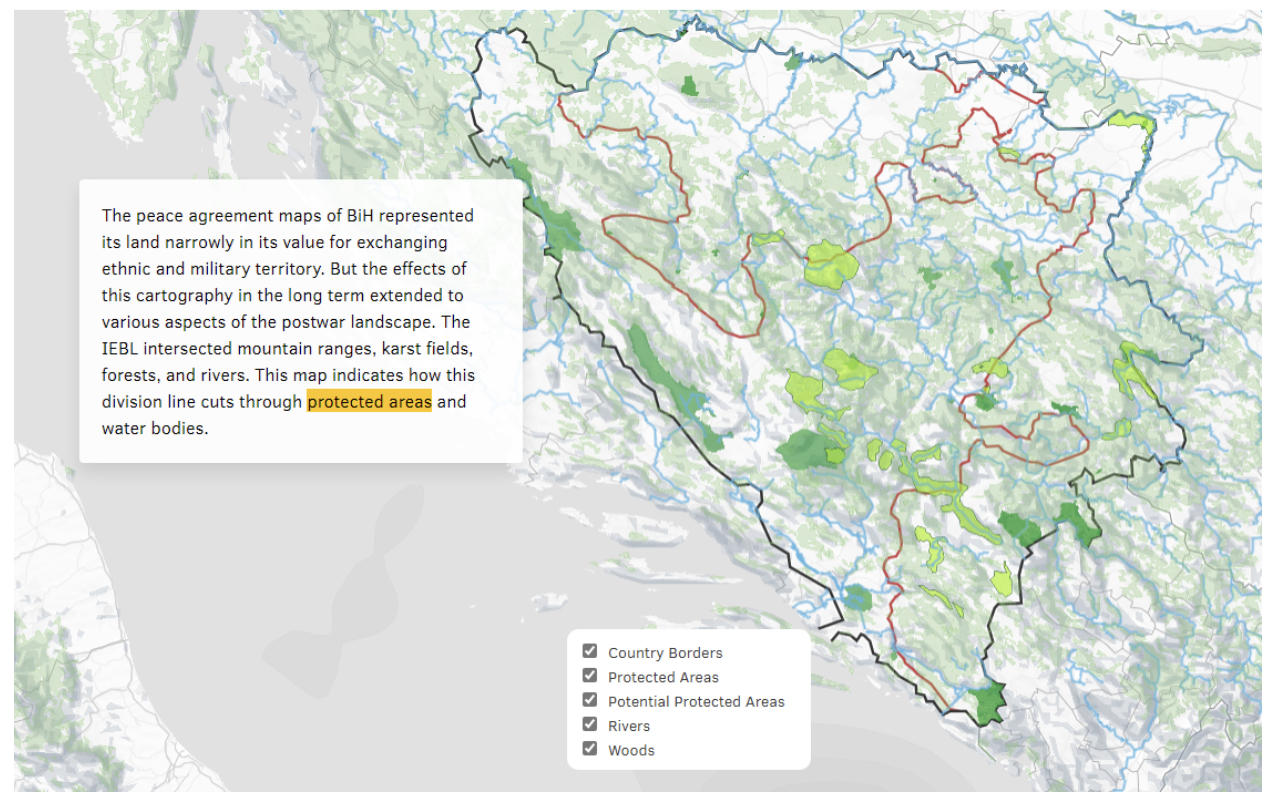
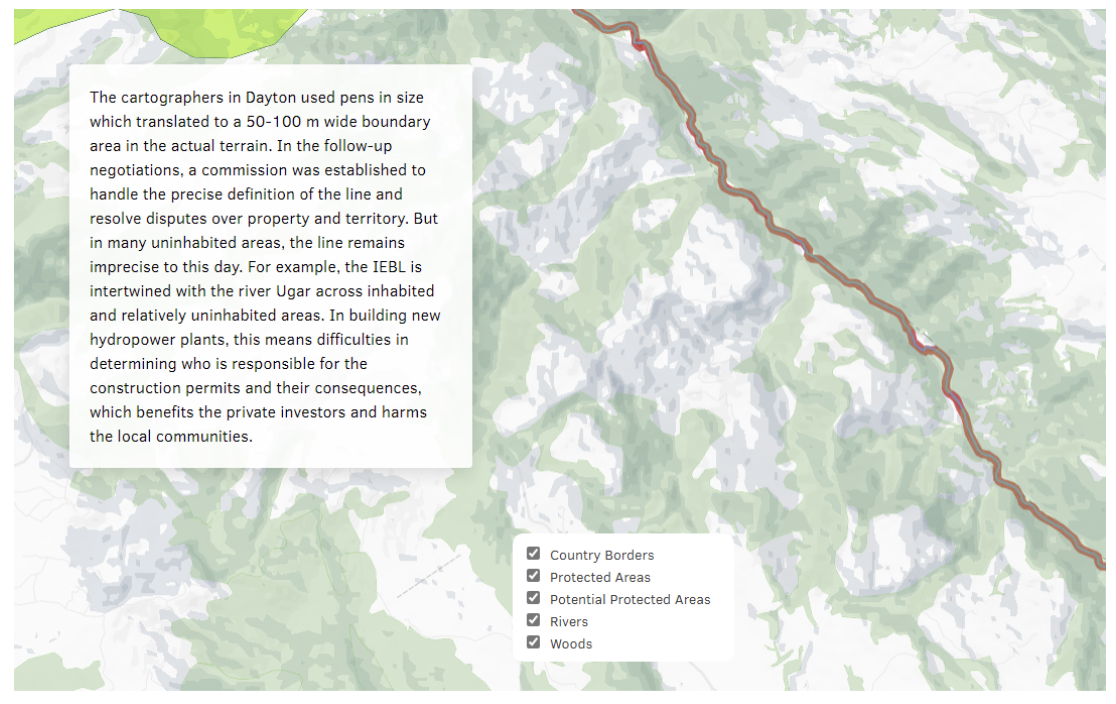
The peace agreement maps of BiH represented its land narrowly in its value for exchanging ethnic and military territory. But the effects of this cartography in the long term extended to various aspects of the postwar landscape. The IEBL intersected mountain ranges, karst fields, forests, and rivers. This map indicates how this division line cuts through protected areas and water bodies.

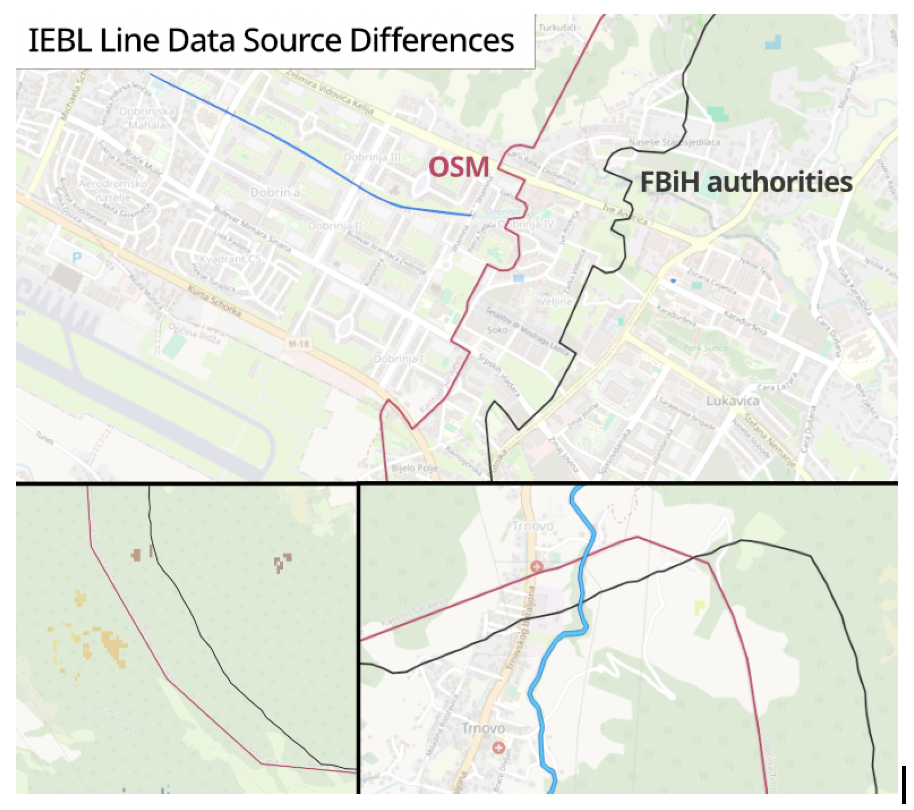
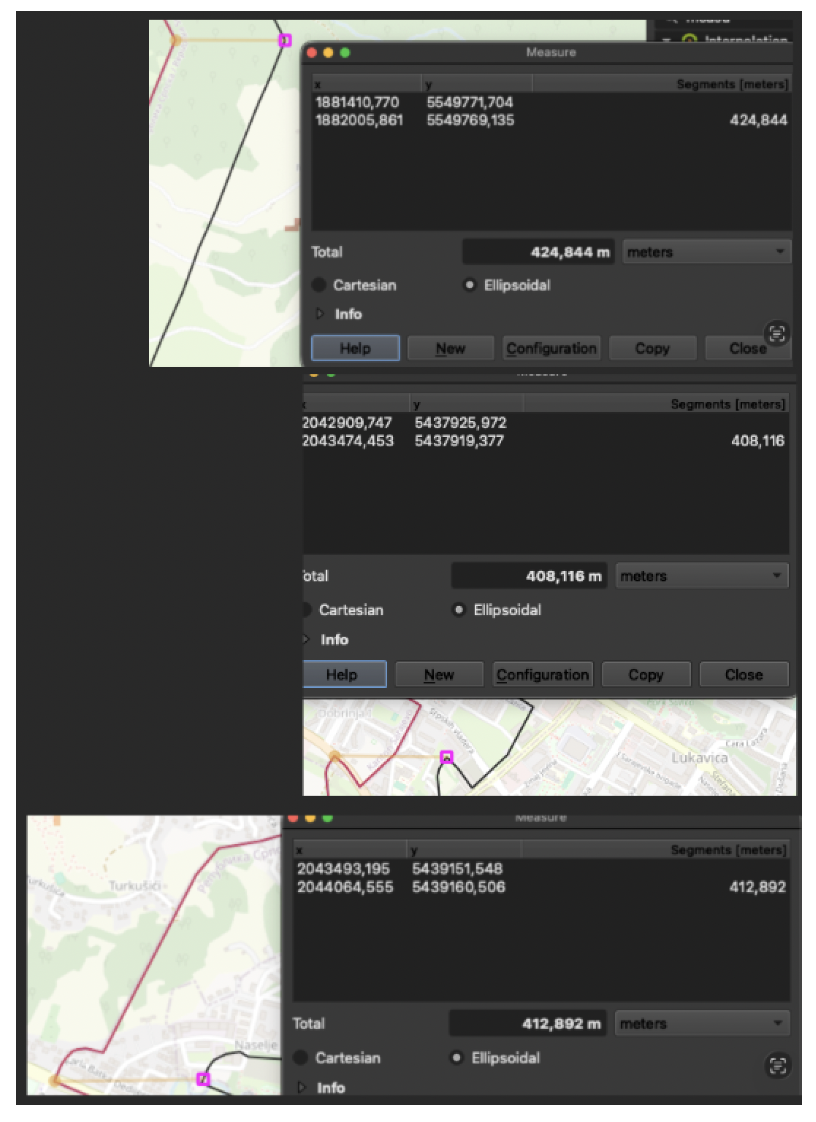
The cartographers in Dayton used pens in size which translated to a 50-100 m wide boundary area in the actual terrain. In the follow-up negotiations, a commission was established to handle the precise definition of the line and resolve disputes over property and territory. But in many uninhabited areas, the line remains imprecise to this day. For example, the IEBL is intertwined with the river Ugar across inhabited and relatively uninhabited areas. In building new hydropower plants, this means difficulties in determining who is responsible for the construction permits and their consequences, which benefits the private investors and harms the local communities.

The imposed solution of the IEBL had no grounding in the geographical or historical context of BiH. This imposition marked the incompetence of peace talks to deal with the complex spatial reality in terms of the multiethnic patchwork, regional and landscape complexity of Bosnia and Herzegovina. The division line, in its ambiguous width, cut through cities, streets, but also the houses of people, as it was the case in dividing the city of Sarajevo. Regional development and local administration were completely transformed, as the DPA led to the creation of new municipalities and division of land use regulation, energyscapes, and water systems.

As the IEBL deeply affected regional and spatial development, it is not surprising that it has had long-term effects on the environment and landscapes in Bosnia and Herzegovina. To trace these effects, it is important to understand the proximity of environmental issues and conflicts to the line, but also how the territorial division is mobilised by different actors involved in these issues and conflicts.

Environmental Legacies of Dividing BiH

Legend
Legend for the environmental conflicts map.

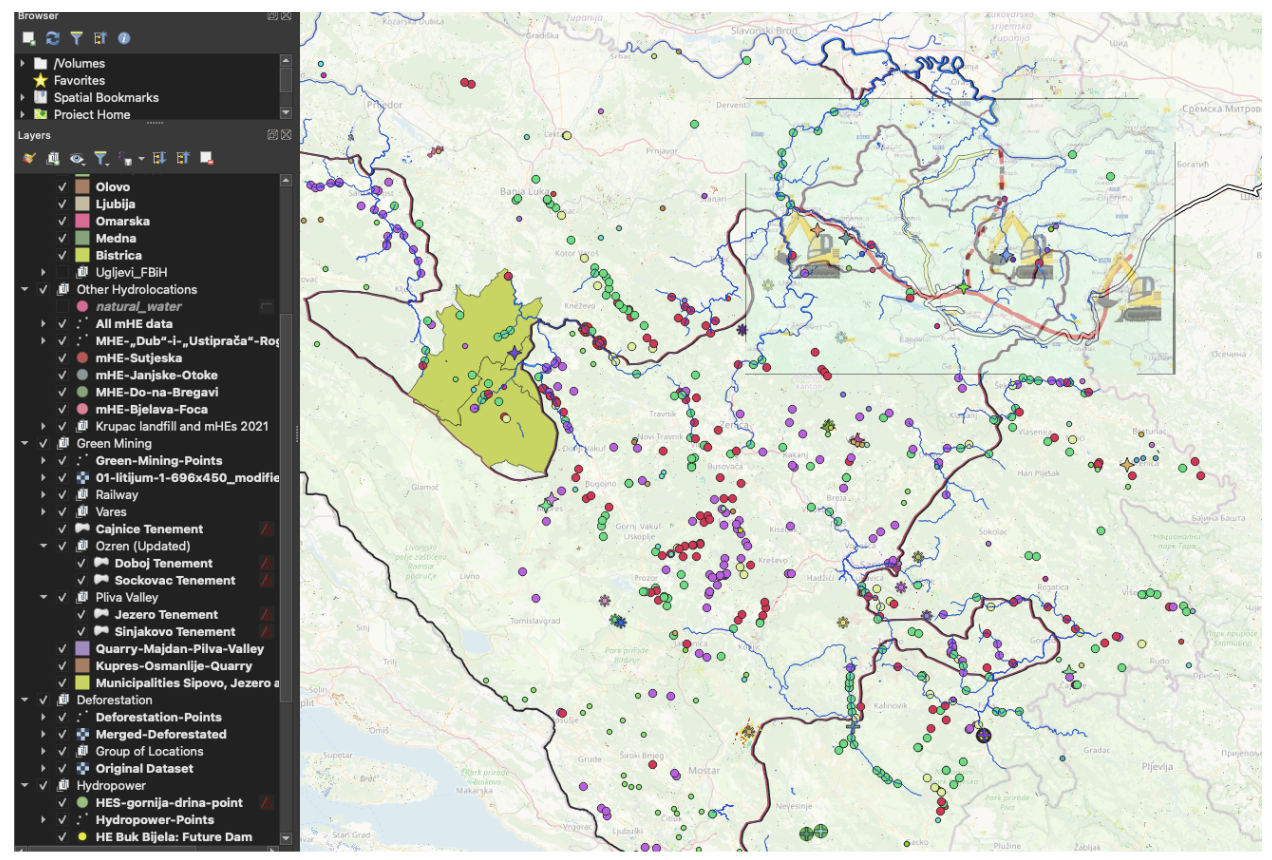
This map shows environmental conflicts in BiH related to three topics: hydropower, mining, and deforestation. The selection of these topics was based on media analysis and interviews with environmental activists, which identified them as crucial for understanding the relationship between the territorial organisation and environmental degradation. The map is limited to conflicts and issues visible in the public discourse in the recent period (2020-2025). It is important to highlight that the map presents all identified conflicts, including those with less visible relations to the IEBL or the territorial organisation of BiH. Starting from this map, the research traced and analysed the conflicts that are influenced by the territorial division and mobilisation of the IEBL. By scrolling down, the visualisation will zoom in to specific sites and projects which present some examples of these connections. 

In the mountain of Trebević, construction companies develop luxury apartment projects. This mountain is cut by the IEBL into two entities and two different categories of a protected area. These projects often involve political and economic elites from both entities, trading land access in a quid pro quo arrangement. For instance, companies backed by political figures in FBiH develop forestland in RS, aided by local authorities who grant permits and waive environmental regulations. Construction of hotels and apartments on the RS territory of Trebević mountain has detrimental consequences for neighbourhoods in FBiH, e.g. in the city of Sarajevo where ground erosion and landslides are exacerbated by these developments.

With some of these projects, land that was evaluated as ‘worthless’ during the peace talks recently became a site of value. ‘Green’ mining companies target the mountains, while energy conglomerates seek to own segments of rivers and karst landscapes for new hydro projects. Geological explorations searching for critical raw materials, such as lithium in the Majevica and Ozren mountains, lie in areas for which Richard Holbrooke exclaimed that ‘there’s nothing there’. Mountains and forests are designated as state property, and entities don’t have the authority to use and exploit state land. But they have been doing so under a legal interpretation by the Office of the High Representative, which has allowed them to issue temporary concessions to private companies. This has reinforced the power of entities over the state and local level in spatial and environmental planning.

In the municipality of Lopare on the slopes of Majevica, Swiss company Arcore AG is currently doing geological research into potential lithium reserves. If the mining starts, it will strongly affect the plans to protest the natural area of Majevica. It will also most likely be harmful to the large population whose livelihoods depend on agriculture. To resist the planned extraction activities, the local community in Lopare has formed a coalition with the residents of Čelić, a municipality across the IEBL in FBiH, which would also be strongly affected by the mining. Along with other local communities, they have been collaborating on a project to protect the Majevica mountain and focus on the development of tourism in this area.

Such local resistance groups which fight against mining explorations are continuously marked as motivated by ethnic interests. The collective titled “Stop mining in the Pliva Valley” recently pointed to the practice of marking activists as enemies of RS. In this valley, an Australian company with local ties (Lykos Metals Limited) is planning to develop several projects to mine for silver, gold, lead, copper and other resources. The mining lobbyists and investors collaborate with nationalistic media outlets in RS to perform smear campaigns of discrediting activists, and environmental experts by claiming they are paid by political actors in the FBiH.

The HPP system Gornji Horizonti was initially designed in the former Yugoslavia but later abandoned due to the high risk of severe impacts on the karst landscape of Herzegovina and the inability to reliably predict its consequences for groundwater and river systems in the region. However, Republika Srpska has decided to revive the project, beginning construction with a canal in Fatničko Polje and the Dabar hydropower plant. The system has been fragmented into a series of smaller projects to circumvent a comprehensive assessment of its overall environmental impact. While the benefits will largely accrue to political elites in Republika Srpska, the environmental damage will be severe across the IEBL in FBiH, where underground water flows and tributaries of the Neretva River are likely to be drastically reduced—or even dry out entirely.

Austrian company Kelag International GmbH invested into two micro HPPs on the river Ugar, a river which criss-crosses between entities. The company received permits in RS and benefited from its legislation, even though the HPP facilities partially or completely extend into the other entity. Only a state level authority was allowed to issue concessions for such projects which span across the entity border. This did not prevent multiple local and international politicians from supporting the project, which has strongly affected the river landscape and ecosystem of Ugar.

The mobilisation of the territorial division goes both ways, from making use of the IEBL ambiguity in constructing facilities close to the IEBL, to claiming exclusive entity rights to extraction. Buk Bijela, a major HPP project was recently declared by political elites as a vital entity interest which is to be undertaken in the ‘inner territorial waters’ of RS. This project was halted by the Constitutional Court of BiH as it is planned to be built on the Drina River in the area along the BiH–Serbia border recognised as state property and territory. Despite ongoing legal and civil challenges at both local and international levels, Republika Srpska and Serbia continue to pursue their joint plan to develop a system of hydropower plants on the Upper Drina, beginning with Buk Bijela.
 

HPP Ulog and its connections to the IEBL

Elites and investors find ways in which the IEBL can work for them e.g., as an instrument for circumventing or ignoring administrative, legal and ethical procedures. In one hydropower example, the entity of Republika Srpska allowed the construction of the HPP Ulog dam on the river of Neretva, which will mainly have negative effects on the territory of the Federation of BiH. The local communities most affected by its geoseismic risks and biodiversity destruction have limited access to legal means to address the investors and authorities in the other entity. This is exacerbated by the ambiguity of a thick borderline drawn in Dayton, which was later unresolved to a precise boundary. This map presents the perspectives of different actors involved in the HPP Ulog case: the investor, the RS government, the FBiH government, activists and the local community. 

Explore the different views by clicking on the four map parts

ABOUT THE AUTHOR

Mela Žuljević is a researcher with a PhD in architecture working at the intersections of design, cartography and political ecology. She is currently a postdoctoral researcher at the Leibniz Institute for Regional Geography in Leipzig, exploring how war legacies shape new environmental conflicts, while counter-mapping postwar extractive development projects. Previously, she studied Visual Communication at the Academy of Fine Arts in Sarajevo and worked as a researcher and lecturer in Mostar, BiH.